by tmoffett | Oct 22, 2010 | Color, Landscape, Photographic Philosophy
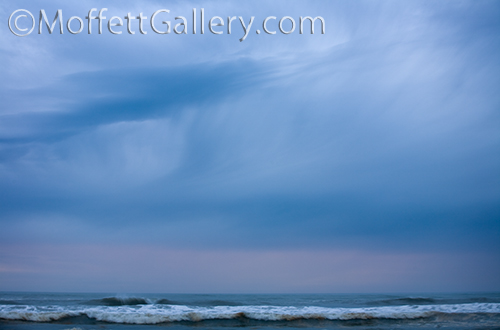
Stormy Sunset, Seaside Oregon
Simplicity in an image brings power. This is a hard concept for beginning photographers to grasp. In our complex lives it is hard to cut out the clutter in our minds and recognize the simple things that are so beautiful. This goes not only for image making, but for our lives as well. Because multitasking is normal, our minds have a difficult time slowing down, if even for a moment. While difficult to do, it has become a necessity for me. I take time to ponder and meditate, to not only look but truly see, not just touch but feel my environment. As I take time to absorb my surroundings I am better able to reduce a scene, visually, to its foundation which is where its beauty lies. Only then am I able to capture it simply and emotionally.
My process when photographing is not fast. It is slow and thoughtful. Often I will set up my tripod and camera and then look and think and ponder. “What drew me into the scene?” “Why did I set up my camera here?” These and numerous other questions go through my mind as I determine what it is that the image is to be about. Then I check the viewfinder and check it again, set exposure settings and check the viewfinder again. Eventually I press the shutter. The entire process is an experience. The whole experience becomes the photograph, an image that hopefully can be felt by the viewer, but if not, it is experienced by me and I am satisfied.
by tmoffett | Oct 18, 2010 | Color, Landscape, Photographic Philosophy
Pacific Wonder
My best photographs are made when I am in a “zone,” so to speak. I am oblivious to the many distractions around me and am in tune with my subject matter. In the landscape, I am in touch with nature. I can feel the crisp air, smell the scents of nature, hear every sound from the rushing water to the birds chirping. It is an experience. The images created are a reflection of the experience. Hopefully they create a visual and emotional experience for the viewer.
Technique plays a very important part in creating the visual experience, however it is not something that I am constantly thinking about. It has become a part of me. It just happens. Otherwise it would possibly get in the way of the creative experience. In the formative years of my photographic career I spent many hours honing technique. I studied. I photographed. I printed in the darkroom. I photographed more. I read more. I studied more. I worked harder. I made mistakes. I tried to learn from my mistakes. Photography slowly became a part of me.
I continue to read and study. I love working with other photographers. But when I photograph, I photograph. The technique just happens. I don’t question what I do. I just do it. I often am amazed at the results. When I listen to my inner self, good things happen. My own feelings are evident in the images created in this manner. It is as though I am opening up my innermost feelings and passions to the entire world, yet there is enough room for personal interpretation that the viewer may see something completely different. I can see myself in my images while others may not. I like it that way. For that reason I will rarely discuss the “meaning” of my images. I prefer the engaged viewer to determine meaning. I feel better that way. And that to me is what photography is all about. Feeling.
by tmoffett | Oct 16, 2010 | Color, Composition, Landscape, Photographic Philosophy, Uncategorized
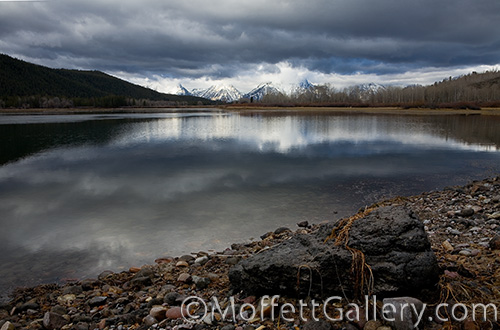
The Tetons
Landscape photography is so much more than just snapping pictures of scenic areas. We must deal with finding a the scene, analyzing composition and working with the light that nature gives us. That doesn’t mean that we make photographs of scenic places under the light that is there when we conveniently decide to be there, wherever there is. It means that we may get up at 4:00 AM and go out in the winter cold in order to arrive and be ready when the morning light first breaks over the horizon. It may mean that we suffer in the late summer heat to find our location and composition and then patiently wait for the setting sun to deliver the quality of light needed to create the mood in our photograph to say what we want it to say. Some days I will set up and wait, only to have the light fizzle out and not deliver. That’s okay. It’s just part of being a photographer.
Learning your craft, really learning it, is a major part of becoming an artist. We must understand the technical aspects of the camera and composition first, and then when photographing from the heart we are able to create masterpieces without having to think logically during the process. We can truly work on an emotional level only when we can work on the technical level without thinking about it. It must become a part of us. I see many students who refuse to learn and master the technical and then wonder why their photographs do not have the emotional impact that they would like. Photography is a blend of art and science, and we must comprehend both if we are to master our craft.
by tmoffett | Oct 11, 2010 | Black and White, Composition, Landscape, Photographic Philosophy
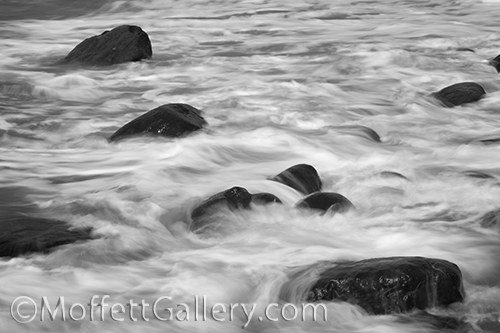
Rocky Shoreline, 408 Trail, Yachats, Oregon
Shorelines is a portfolio of photographs that I have been working on for about a year now. It is all about water and land interaction along shorelines. Both ocean and lake shorelines are included in the series. I spend a lot of time in the outdoors, not only photographing, but fishing and just enjoying nature. I have been intrigued with water and land interactions for a long time. I have noticed both erosion and new life along the lakes I have camped at. Along the ocean I see the changes that happen with rising and ebbing tides. The calm waters in a tide pool or the rough waters of a stormy sea. It seems that the waters of the deep have little change, but at the shoreline the change is constant.
I have visited the same locations multiple times and never found the same thing twice. Ona Beach along the Oregon Coast, for one, in June had some incredible rock formations covered in moss along the shore, but in October those rocks are completely covered with sand. This occurs due to the shifting sands throughout the year. The light on a clear summer day will create a totally different look and feel than I will find on a stormy fall evening.
When photographing along a shoreline, I like to keep a sense of stability by maintaining some element in crisp focus, while letting other area blur with the motion of the water. In this image, the rocks protruding from the water provide that stability to the image, while the fast moving waters create a sense of movement and flow. The busyness of a stormy sea in contrast to the stability of solid rock. I can read the story of my life in the photographs that I create, but instead of telling my story, I want you to see yours.
by tmoffett | Oct 10, 2010 | Color, Photo tips, Photographic Philosophy, Ramblings
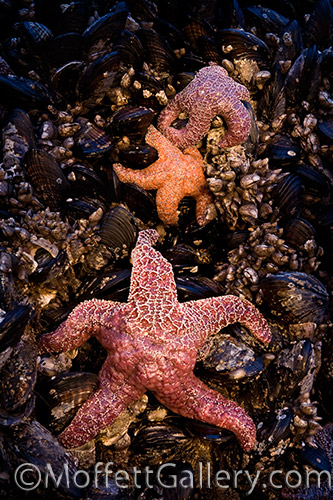
Starfish
While on the Oregon coast, low tide was an hour past sunset, so photographing at that time meant improvising lighting. I really dislike using flash as it is harsh and flat. My students all know how much I dislike it, as I don’t allow them to use it on camera. If I was going to photograph the tidepools, I needed an alternative source of light. I opted for a Mini Maglight which is a small flashlight that I carry with me in my truck all the time. This light would produce a warm light (extremely warm if you don’t correctly white balance!) in contrast to the very blue light from the nighttime sky.
After determining composition and setting up the camera, I carefully calculated exposure, and then used the trial and error method to fine tune it. I determined that about 90 seconds would be needed to illuminate the starfish. I set up, opened the shutter and began painting. At about 75 seconds a wave came from nowhere and forced me to retreat! This happens all to frequently on the ocean. You must be ready! When the wave came in, I had just finished painting the starfish and was working on the background area. Upon inspecting the image and the histogram on the cameras LCD monitor, I decided to leave it alone. I liked the dark surrounding and the cooler tones around the fish. It added a little bit more depth to the image. Success!
Students often tell me that it is too dark to photograph. Not true! You just have to look at alternate methods of lighting your images. Often, these alternative methods will produce much more interesting results than shooting when it is light outside. We must, as artists, be creative not only with our vision, but also with our technique. Learning technique so well that it becomes a part of us is so important. With technique under control, we are then able to concentrate on our vision, how we see and present our vision to others. That is when we truly become artists!
by tmoffett | Oct 8, 2010 | Color, Landscape, Photographic Philosophy
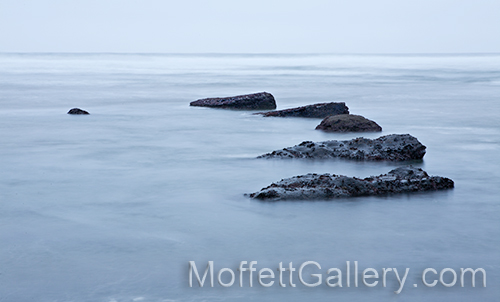
Nightfall
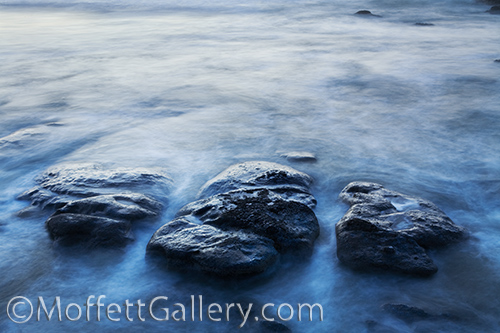
The evening last night was a very interesting one on the Oregon Coast. Rains fell, the quieted down about 45 minutes before sunset, which we couldn’t see due to heavy clouds. The winds blew which made for some very violent wave action. However, I really wanted to show a more quiet, dreamlike look to my photographs, so I set out to accomplish that. I found a little cove that was somewhat protected from the elements, but the waves still made their way in. As they entered the cove, they washed over these rock outcroppings. By shooting with a very slow shutter speed, the waves were reduced to gentle swells. The blue color adds to the feeling and shows the late hour in which I was shooting, but most of all it adds mood. The technique used appeared to have calmed the violent sea and portray a quiet moment on the ocean.
Being able to create images that not only show and create feeling, but show MY feelings, is a challenge that I desire to always pursue. It is especially challenging when the environment and conditions have and opposite mood and feeling than I have. I have learned, though, that it is not impossible to accomplish. Mastering your craft is a necessity if you are to create personal masterpieces.

Recent Comments