by tmoffett | Jul 11, 2010 | Color, Family, Random images
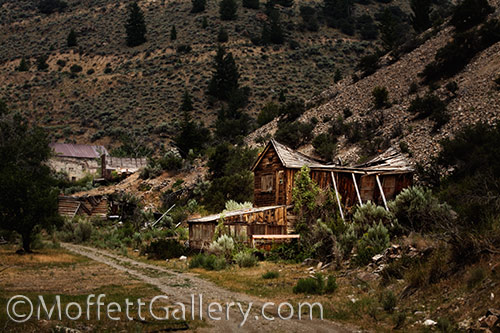
Bayhorse, Idaho
Just up the road from the kilns that I posted yesterday is the city of Bayhorse. In its day it was a booming mining town. The first miners moved in hoping to find gold, but it was silver that was in abundance here. Now there is nothing left here, but just upstream there is a little lake that has some terrific fishing. That is where we were headed when I stopped to photograph for a while. I love to fish, but if I have to choose between fishing and photographing, the camera nearly always wins out. Just ask my kids! They often get tired waiting for me to get the shot. Instead of hearing “Are we there yet?” on a family trip, it is “Hurry up dad, we’ll never get there at this pace!” This day was no exception.
We still got to the lake in time to catch some fish.
by tmoffett | Jul 10, 2010 | Color, Landscape, Photographic Philosophy
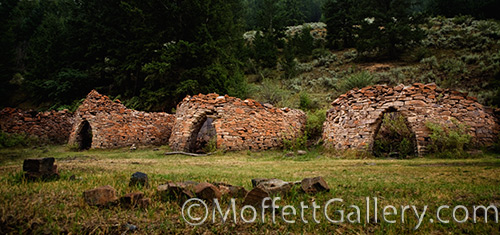
Abandoned Kilns
As a landscape photographer, I don’t find myself drawn to structures very often, however on a trip to the old ghost town of Bayhorse, Idaho, we passed these old abandoned kilns and I had to stop. I have since thought about why I needed to stop. What is it about ghost towns that we are drawn to?
Bayhorse was a booming mining town in the 1880’s and 1890’s. these kilns, along with 3 others are where charcoal was made to fuel the smelters. I can imagine these in full operation. It was a very busy place. And now, nothing. Empty. Only a figment of our imaginations.
It is amazing to me how a place can be so full of life one day, and totally deserted the next. The emptiness is what I felt as I pondered what I was photographing. That is what I wanted to portray. I think it shows. I know I feel it again when I view the image. The soft light coming from an overcast sky helps create the feeling, as well as the darker, moodier interpretation of the final print. The rocks in the foreground also enhance the feeling of abandonment and decay. I hope you can feel it as I do.
by tmoffett | Jul 9, 2010 | Architecture, Color, Critique, Photographic Philosophy
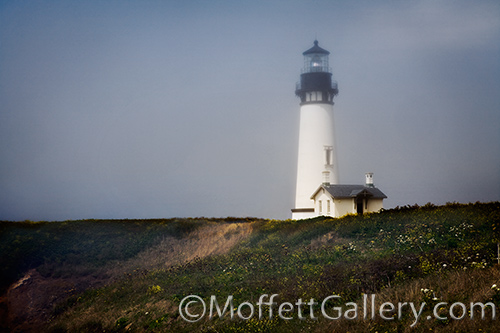
Yaquina Head Lighthouse
I don’t know what it is about this image. I initially didn’t think too much of it, but every time I have reviewed the set of images from my Oregon Coast 2009 trip, this one stands out more and more. It is kind of growing on me, I guess.
I have found over the years that certain images will really appeal to me initially, and over time kind of fade away, and others will take time to grow on me, but I seem to never tire of them. For this reason, I always do an initial edit of my work, but review it several time over the course of several months or even years. Often I find little gems that I missed at first. This is one of those.
When I was at Yaquina Head, the fog was rolling in from the sea and you could barely see the top half of the lighthouse. We hiked down to Cobble Beach and occasionally the fog would grow thin and you could see the top, however it left a unique softness to the image. I think that is what is drawing me in. The subtle color and softness create a very passive feeling, very relaxing to look at. It is very different from the stark, crisp and sharp architectural images that we are used to seeing. I kind of like it for a change.
by tmoffett | Jul 8, 2010 | Landscape, Photographic Philosophy, Uncategorized
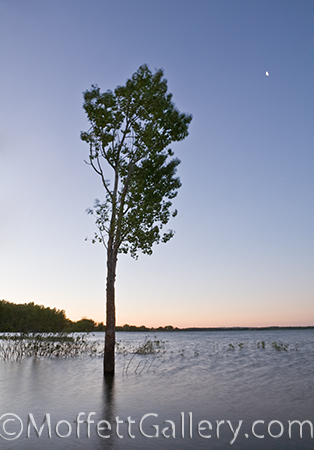
Solitude
I love shooting photographs of the local areas. I feel that I get to know them, yet never tire of them. It seems that I see something different every time I return to a familiar place, or maybe I just see the same things differently. The light is always changing, so the same things can look totally different from day to day. I challenge you to go back to a favorite location many times over the course of a year and see how many different images you can create.
Lake Lowell is my “fallback” location. If I am wondering where to go, I go to the lake. I originally planned to do a 15 print portfolio from the lake, however by the time I had 15, I felt like I was just starting, so I kept going back. This is an image just shot this week. I was at one of my favorite evening locations, but this time in the morning. There was a completely different look in the morning than at sunset. Just prior to sunrise there was a coolness to the light. Everything was blue except for the western horizon which had a touch of red. Not a cloud in the sky and the breeze was blowing creating some motion in the trees and the grasses. It was cool for this time of year, and the bluish color enhanced the coolness in the air. The lone tree, surrounded by water in the cool, crisp morning air creates a cold, lonely feeling, but reaching out, not far away is the warmth of the rising sun.
To me, photography is all about feelings. If an image causes you to feel something it is a success.
by tmoffett | Jul 7, 2010 | Color, Photo tips, Random images
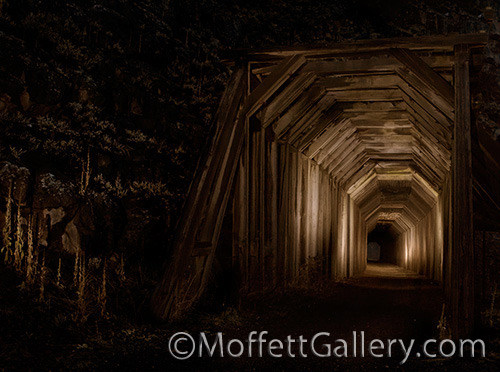
Tunnel Vision
This image brings back great memories! I was with a couple of friends out photographing in Eastern Idaho and we hiked down to this tunnel. It was light when we arrived and the scenery in the area was great. We shot until dark, and then some more. We then realized that none of us had flashlights and it was pitch black. No moon out and away from the lights of the city. We stumbled our way out and finally made it back to the truck. It would have been quite funny to watch us. It was all worth it, though. I also learned to keep a light with me at all times, because you never know when you might need it.
Back to the image. As it was getting dark, the tunnel became quite interesting. I could see a faint light at the other end and the wood trusses created an interesting pattern. The only light available was my Canon 580EX camera flash. I decided to send one of my friends into the tunnel and pop the flash. I ran a test and determined where and with what power to use the flash, then I locked the shutter open and we went to work. We used 8 flashes inside the tunnel and when my friend returned we popped the landscape twice, skimming the light across the surface instead of blasting the light directly into it. In all, the exposure was about 3.5 minutes.
Learning to use and control the light that is available to you is very important as a photographer. It will allow you to make creative images in places and at times that others cannot because they lack the necessary knowledge and skill. It will open new doors for you to explore, and if you are at all like me, you like exploring new ideas.
by tmoffett | Jul 6, 2010 | Color, Composition, Landscape, Photo tips
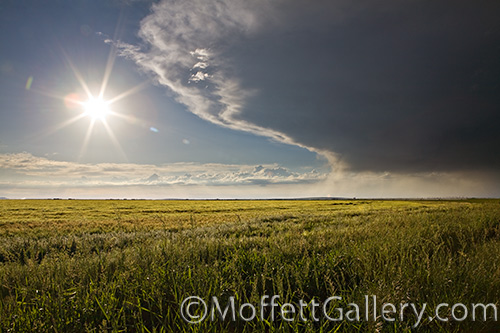
Approaching Storm
I have always taught my students that photographing on the edge of the light is always best. Then the other day, John Paul Caponigro made a comment on Facebook relating to photographing on the edge of situations. It made me think, “Am I missing something here?” I believe I was.
Look at the approaching thunderstorm in this image. Where I am? On the edge. I have been able to capture the beauty of the storm, partially due to the fact that I am also using interesting light. What happens as you get caught in the middle of the storm. I did a few nights ago, and I tell you it wasn’t as pretty as this! The light goes away, it is dark. There is no direction to the little bit of light that there is, so it is flat and dark. Double whammy. Oftentimes wet and miserable as well.
As I look back at past images as well as events that I have covered, I have found that the best images usually do come from the edges. Don’t neglect completely the center, but do make sure to at least explore the edges, you just might find your next masterpiece there.
by tmoffett | Jul 5, 2010 | Color, Landscape, Photo tips
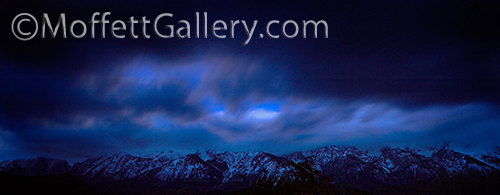
First Light
When in the morning do you begin photographing? Many photographers wait until the sun rises. I, on the other hand, will begin much earlier. I have found that many of my best images have been made long before the sun rises or long after it has set in the evening. I find the light to be quite fascinating prior to sunrise and after sunset.
This image, “First Light,” is just one such example. I was out with several photographers one morning and everyone, except me, was looking around and setting up cameras for their first shot, as the sun rose over the horizon and skimmed across the landscape. Yes, that would be impressive, but instead of mapping out what would later become a good image, I was searching for what was a great image right now! The western sky was wonderful! The light was already hitting the clouds coming over the mountains just a little, just enough to be able to capture them. This is my favorite image from a wonderful morning of photographing. The long shutter speed created some motion in the clouds to create some mystery, enhanced by the dark mountains below them.
I always teach to use a tripod, even when you think that you don’t need one. It forces you to slow down and think while you compose and shoot. In early morning and late evenings, it is a necessity. Also, using a cable release and the mirror lockup function on your camera helps to ensure that the camera is completely stable during the exposure. Using these techniques, the mountains are rendered completely sharp while the motion in the clouds creates the mood and feeling. Exposure in these situations is also extremely critical. A little over and the subtle highlights in the clouds will be ruined, a little under and the detail in the mountains is lost. Just right and you have a masterpiece!
Slow down, think, compose, expose. Take these steps and watch your images improve.
by tmoffett | Jul 4, 2010 | Color, Random images
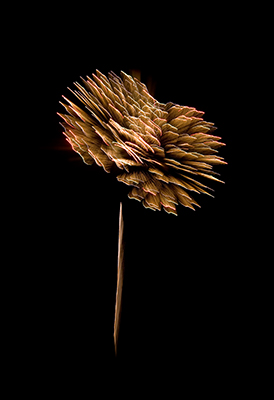
Blossoms of Fire
Happy Independence Day! Enjoy some of my fireworks images from past Fourth of July celebrations. I try to shoot with a little different twist than others do. All of my fireworks images are in camera effects. I do not add any Photoshop effects later.
Up until just a few years ago, I had never photographed fireworks. I loved watching a good show, but had no desire to duplicate what everyone else had done. I thought that most images of fireworks were predictable and boring. Then during one show I got an idea, so I took my camera to the next fireworks display that I had a chance to see, tried out my idea and was very pleasantly surprised at the results. There is more depth and dimension to these than most. Here are a couple more images. I hope you enjoy them.
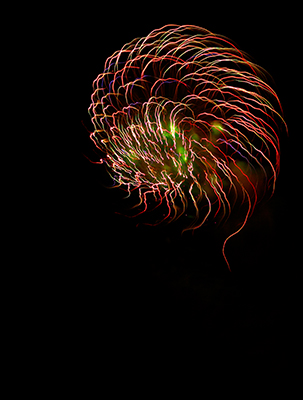
Thing 1
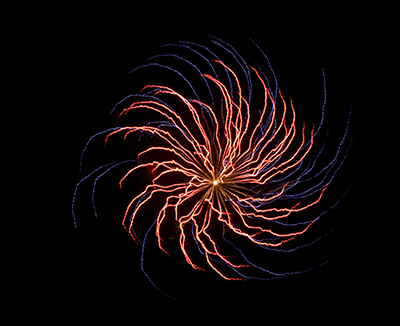
Spinner
by tmoffett | Jul 3, 2010 | Color, Composition, Random images
Concord Leaf
I remember while in school years ago, Ruth Bernhard chewing a bunch of us students out for traveling a distance to make our photographs. She referred back to her famous teapot image and told how she picked the teapot up off of the street, all beat up and smashed. She took it to the studio and created a masterpiece. She then told us that we should be able to make images in our own backyards.
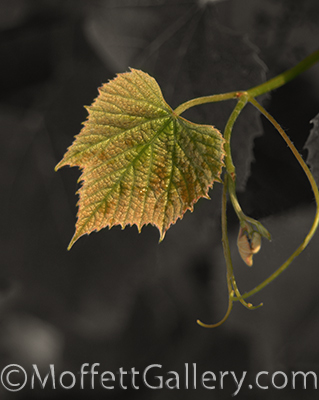
I pulled in the driveway one evening and saw the new grape leaves on our vines right next to the driveway. The evening light was skimming across them and seemed to highlight just this one leaf. It was beautiful. Ruth’s words flowed through my mind. I grabbed my camera and began shooting, and this is what I came up with.
The light was nice, highlighting the texture, however the color in the background seemed to get in the way of the image. I have often told my students that if anything in the frame does not help the image, then get rid of it! So I eliminated the color in the background. All I see now is the new life that comes every Spring to the vines. Eliminate and simplify, two concepts that if mastered will surely help create a more powerful image.
by tmoffett | Jul 2, 2010 | Color, Landscape, Photographic Philosophy
Fire In The Sky
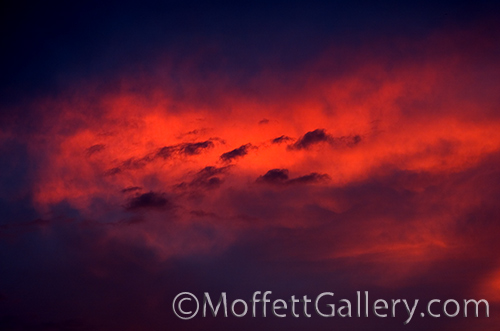
Sunsets seem to capture everybody’s attention, and this one did for me. I will usually make sure that there is an interesting foreground, or even a silhouetted subject, but sometimes the clouds themselves can be the subject. Alfred Stieglitz did it in his series that he called Equivalents, so it must be alright! This is definitely no Stieglitz, but it does have its own merit. The color in the sky was incredible, and that alone became the subject here.
On the subject of Stieglitz, I too have a series of cloud images. I love Stieglitz’s work. Other photographers who I like and who have influenced me in my photographic journey are:
1. Paul Caponigro. He is my all time favorite. His images have feeling. I could look at them all day, every day and not tire of them.
2. John Sexton. Another master of black and white. He really knows and understands light. You can learn a lot from just studying his images.
3. Edward Weston. His series of peppers shows that you can find beauty in the ordinary.
4. Ruth Bernhard. I met her while in school. Interesting philosophy of photography. She taught me to stay at home and photograph there. You don’t have to go to exotic places to create meaningful images.
5. John Paul Caponigro. Very different style than his father, but very good. His thoughtful, philosophical approach to image making is incredible. He once reviewed my portfolio and I learned more in that half hour about meaningful photographs than I had in the previous year.
6. Joel Meyerowitz. His use of color is unrivaled. His conscious use of light and color are inspiring.
7. Yousuf Karsh. My favorite portrait photographer ever. His simple style and elaborate use of light made portraits that were simple in style yet very complex in meaning. He taught me how important it is to get to know your subject before photographing them.
8. Ansel Adams. Ansel has to be on the list. The zone system came from him. Zone system taught me about light and how to find quality light in nature.
9. Craig Law. Master Carbon Printer, and his silver prints were nothing to be ashamed of either. I endured many a critique under his tutelage at Utah State University. In my four years at USU he became a great friend as well as mentor.
10. R.T. Clark. Another Professor at Utah State. He taught me the importance of near perfection. I did more “reshoots” for him than any other instructor. I don’t regret it. I learned more by breaking down an image and rephotographing than I ever could have learned in a critique.

Recent Comments