by tmoffett | Oct 5, 2010 | Color, Landscape, Ramblings
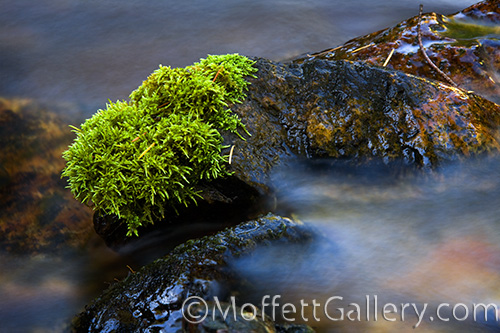
Rocks and Water
Detail photographs can be a great addition to a portfolio to add some variety. I often look for the one great shot and forget to look at the details. You may find that the best image lies within the frame that you have already shot. I like to start with the wide, establishing shot and then work down to the details. Such was the case here. I went from using a 20mm wide angle lens to my 200mm telephoto lens, and it was then that this small stream seemed to come to life for me. The water flowing around the moss covered rocks were inviting me to come closer. And when I did, I was not disappointed. The water seemed to make what color I found in the rocks to come to life. Almost animated. It was a wonderful experience to photograph.
by tmoffett | Oct 4, 2010 | Color, Landscape, Ramblings
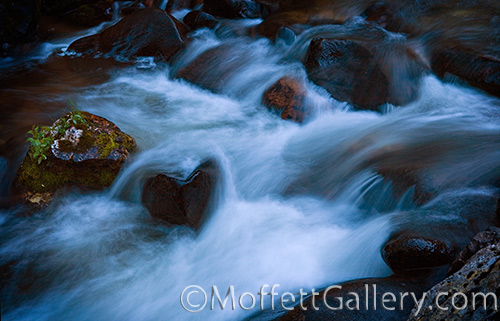
Bayhorse Creek
The soft flowing water in contrast to the sharp, stable rocks and the dark, moody lighting found in the thick brush of Bayhorse Creek caught my eye after a good day fishing at Bayhorse Lake, just a few miles upstream. I love the sight and sound of running creek water in the wilderness. It is refreshing to the soul. This image is a constant reminder to me of what an evening in the woods is like. I can almost smell the fresh air. When I can’t get out, I look at images to cleanse my mind.
by tmoffett | Oct 2, 2010 | Color, Landscape, Ramblings
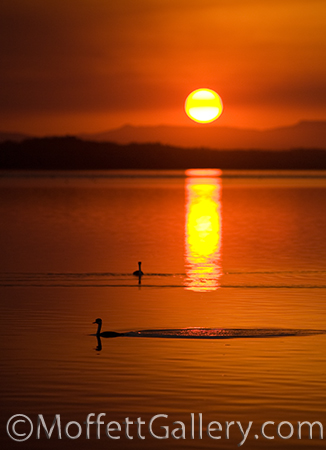
Sunset Reflection
Oftentimes I will find myself shooting east when the sun drops low in the sky. I like the warm light that the setting sun provides. Last night, while out at the lake, photographing the eastern sky, I turned around and saw the ducks swimming through the reflection of the setting sun. I quickly swung the camera around, just in time to capture this image.
I don’t often photograph wildlife, not because I don’t like it, but just because my energy right now is so focused on landscape photography. When I get in a groove, I get tunnel vision of sorts and tend not to see what else is out there. Because of this, I see my landscape work improving and really beginning to “say” something, however I know that I do miss some other photographs that could be very compelling. I am alright with that. I know that finding a niche will breed success. Doing one thing well is much more important to me than being just alright in many areas. My heart is in the landscape. My one desire is to create meaningful images of the landscape. I explore my innermost feelings and express them in photographs created in the world around me. Photography is my outlet. It has become a need. Without it, for me, life would become very difficult.
by tmoffett | Oct 1, 2010 | Color, Landscape, Photo tips
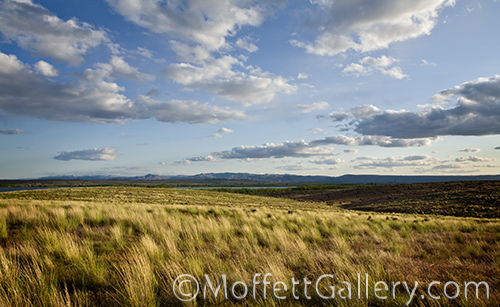
Blowing Brush
I just gave my Photo 2 class an assignment to capture motion in a photograph. We discussed how to show movement and motion and how to stop the motion. We talked about shutter speeds and equivalent exposure. I hope they understood. I will find out over the next few days how well I taught the concept. Most of what we discussed revolved around sports photography, as the need to stop the action is great. As I thought about it, though, I realized that in landscape photography I make decisions relating to motion on a daily basis.
Wind is a very big part of nature. There are many times that I want to show the power of the wind. As the leaves blow, I see the power and beauty of the wind. Properly photographed a scene can come alive. With the wrong settings, a scene can be killed. Understanding your camera and its settings can make or break you in the wind. A slow shutter speed allows the motion to be seen in an image. Set it too slow, though, and it turns to mush. Practice is the only way I know to learn how to capture the wind.
by tmoffett | Sep 30, 2010 | Color, Landscape
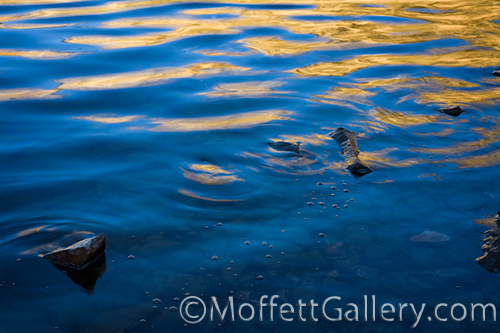
Reflections, Lake Cleveland
Reflections. I love them. The ripples in the water distort them. It’s a beautiful thing. I really like it when I can find warm and cool colors coexisting in a single reflection. At Lake Cleveland the other day I found just that. The rocks provide that little bit of stability to the image while at the same time they cause the ripples, coming in in straight lines, to be broken up and add some circular motion in the water in the foreground. They also add interest and a place for the eye to rest for a moment. Every reflection photograph is different due to the changing motion of the water, kind of like life. Each moment is different and cannot be re-lived. Live to make every moment count.
by tmoffett | Sep 29, 2010 | Color, Composition, Landscape, Photo tips
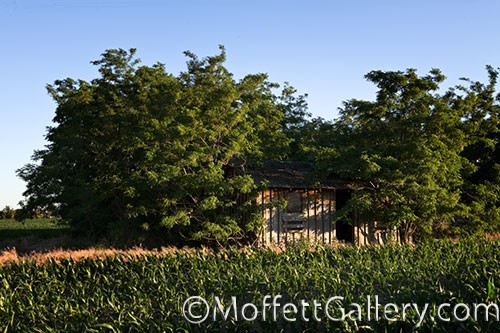
Abandoned, Canyon County, Idaho
Photography means writing with light. If we are going to have quality “writing” we must have quality light. I have had students ask “Why can’t I make photographs like yours?” I nearly always answer with, “You can” followed up with “What time of day did you shoot that one?” I already knew the answer, but needed to ask in order to make the point.
The quality of light changes throughout the day. On a clear day, the warmest and softest light is in the evening, just before the sun sets. Mornings at sunrise are good too. I love working in the evening, as I can watch the light get better and better right through the sunset, and then it changes to a cooler, but still a very soft, moody light. The soft, directional light that happens that last hour before sunset is very sweet. The texture in nature becomes very pronounced. The shadows are deep, yet not blocked up. The warm/cool relationship between highlights and shadows is also more pronounced. It makes for amazing images. Don’t get me wrong, you must still have a vision. The photograph doesn’t create itself, but when vision and light work together you can get some terrific results.
If we want to create images with feeling and power, we must be willing to work when the light is right, even if it is not convenient.
by tmoffett | Sep 28, 2010 | Color, Landscape
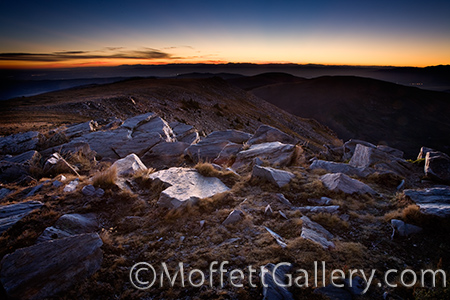
Sunrise from Mt. Harrison
This past weekend was quite refreshing. Friday evening I made my way south a couple of hours to spend a day with some friends. We had a wonderful evening of dinner and relaxation. Visiting, looking at photographs and catching up on the past couple of months. I love “talking shop” with other photographers. It is good for the creative juices within.
Saturday morning, long before sunrise we arose and headed out to photograph Gods creations. We drove to the top of Mt. Harrison and waited for the first light. It was beautiful. I love sunrise. The air was crisp and cool, very invigorating. We shot through the sunrise then headed back down the mountain, stopping at several places along the way to make more images.
Arriving back at the house, we looked at what we had done. It always amazes me that even though we were at the same location and at the same time, we each came up with completely different images. Each of us with our own personal vision, not better or worse, just different. How could I not see what others were seeing? How could they not see what I saw? We are each unique in our own way, and that is what makes life interesting. In my classes, I try to encourage the development of this personal vision in my students. It takes time. It takes effort. It takes learning about oneself. We must first figure out who we are, then our vision will begin to develop. It is a wonderful thing. As I write about my vision and about my photographs, I find my vision developing even more. My images get better as I verbalize my vision. I have become more focused in my work. The meaning of the images have become much clearer to me. My work has become uniquely mine.
by tmoffett | Sep 27, 2010 | Black and White, Landscape, Photo tips
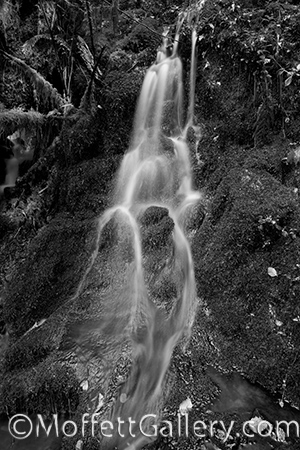
Transparent Falls
One of the most frequent questions I am asked is, “How do you photograph water to make it look like that?”
The answer is quite simple if you understand how a camera works. I use a tripod and long shutter speeds. How long of shutter speed? That depends on how much water is flowing and how smooth do you want it to look. That is the part that takes experience and vision. If you don’t know what you want it to look like, then it really doesn’t matter, but if you know, then you must practice and practice and practice. That is the concept that I find difficult to teach. Many students just want me to tell them what and how to shoot, but I don’t operate that way. I want my students to learn to make good decisions so that when I am not around to answer them, they can come up with their own decisions.
I am currently teaching a unit on basic exposure, apertures and shutter speeds. I am finding that the students who take the time to go out and photograph catch on quickly and those that don’t struggle. It is that simple. Practice and you’ll get it, but don’t and you won’t.
by tmoffett | Sep 24, 2010 | Color, Landscape
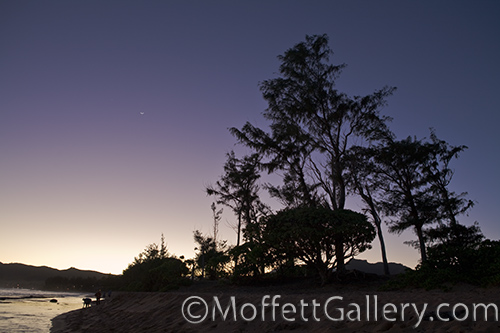
Moon Over Sunset, Kapaa, Kauai
One of the best trips of my life was when Christeena and I went to Kauai. I keep coming back to those photos because of the great memories that they remind me of. It was a much needed trip for us, and we were rewarded with great images all around us the entire time we were there. This is the sunset view from the beach right outside our hotel. I was a beautiful beach to stroll in the evening light. I am so ready to go back. I wish I could do it every year.
One evening we were out and I had been photographing the water and the beach when I turned around and saw this. The silhouetted trees in the sunset and the crescent moon straight overhead was a beautiful sight.I turned my camera around and for a few minutes concentrated on the simple silhouette. In a moment it was gone. With photography you must be ready at all times, because when the light is gone it is gone. If you weren’t ready, then it is too late.
by tmoffett | Sep 23, 2010 | Black and White, Composition, Landscape, Photo tips
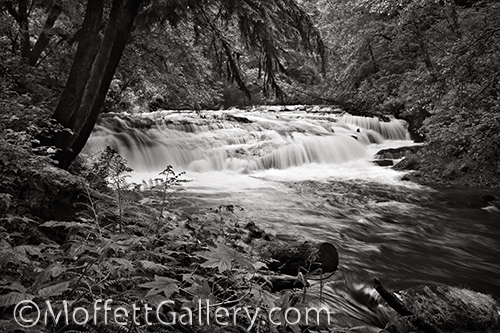
Knowles Creek
One of the most beautiful small rivers I have visited is Knowles Creek in western Oregon. One summer afternoon Christeena and I took a small hike along its banks, and along one section we walked there was nearly a mile of nonstop, staircase type waterfalls. There was nearly too much water to get nice photographs. When it comes to shooting waterfalls, I prefer just a little water as it tends to photograph better than a whole lot of water. When there is too much flow, the water just turns to a white, textureless streak. With less water a soft, ribbon like effect happens. It is much more interesting that way. You can almost feel the flow of the water.
There is just something about kicking back and relaxing on the banks of a river. The sound of the running water and the fresh air of the outdoors is so peaceful and nice. Even the occasional rainfall that came down didn’t disrupt the feeling in the air. I could hang out in the outdoors year round without a problem. It is my kind of life. Just me, my family and my camera. Wouldn’t that be nice!

Recent Comments