by tmoffett | Oct 27, 2010 | Color, Landscape, Ramblings
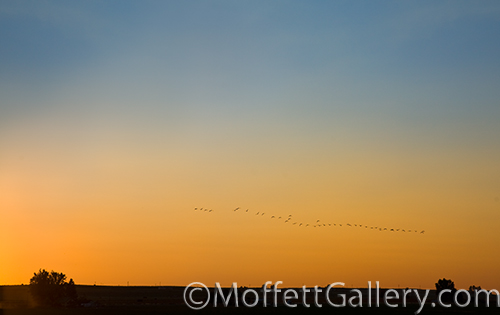
Twilight
October is my favorite month to photograph. The air is cool and refreshing. The colors are great and the light is wonderful. There is a good mixture of sunny days and stormy weather… I love both! Above all, though, the sunsets are usually great.
One particular evening as I was out at the lake, I turned west just in time to see this line of birds crossing through the golden light after the sun had dropped below the horizon. I quickly turned the camera and shot. I didn’t have time to think, I just did it. I was glad to have had enough experience to know where my camera settings needed to be because I only got one frame shot and the birds were gone. It is so important to understand the technical aspects of the camera so that you don’t miss out on these kind of opportunities.
by tmoffett | Oct 25, 2010 | Color, Composition, Landscape, Ramblings
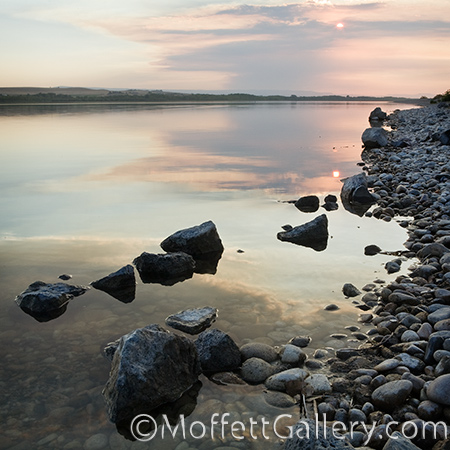
Sunset, Gotts Point
I used to shoot square images a lot. My wedding camera, back in the days of film, was square. I sometimes miss that Bronica. I liked the feel of it. I liked the format. It was refreshing because it was different. It was sometimes challenging to shoot interesting compositions because it was symmetrical. I got used to it and loved it. Now I shoot almost entirely digital. I have one format. Occasionally I still see square, though, and I shoot and crop. This is one such image.
While out at the lake earlier this month, I watched the sun setting and this pastel image appeared before my eyes. I set up my tripod and camera, and rotated from horizontal to vertical and back again. The image was not in the rectangle frame of my DSLR. It was most definitely square. The lines created by the rocks and the horizon leading left to right are strong. The placement of the sun in the upper right, perfect. This is the perfect composition to be photographed square. It has a strong vertical feel to it, yet it is perfectly square. My mind drifted back to my Bronica SQai. I could feel it in my hands as I squeezed the shutter. Even the color of the image is reminiscent of the color from Kodak VPS, my favorite color film that Kodak ever made. The pastel colors rendered warm and inviting. The contrast soft and smooth. This image reminds me a lot of my days shooting film. Those were good days.
by tmoffett | Oct 10, 2010 | Color, Photo tips, Photographic Philosophy, Ramblings
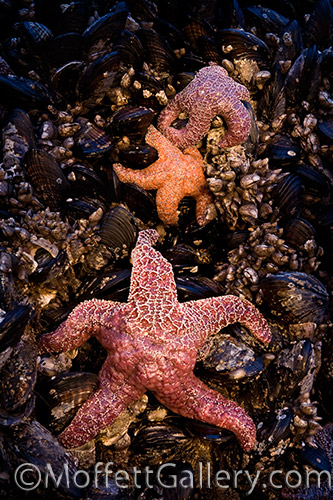
Starfish
While on the Oregon coast, low tide was an hour past sunset, so photographing at that time meant improvising lighting. I really dislike using flash as it is harsh and flat. My students all know how much I dislike it, as I don’t allow them to use it on camera. If I was going to photograph the tidepools, I needed an alternative source of light. I opted for a Mini Maglight which is a small flashlight that I carry with me in my truck all the time. This light would produce a warm light (extremely warm if you don’t correctly white balance!) in contrast to the very blue light from the nighttime sky.
After determining composition and setting up the camera, I carefully calculated exposure, and then used the trial and error method to fine tune it. I determined that about 90 seconds would be needed to illuminate the starfish. I set up, opened the shutter and began painting. At about 75 seconds a wave came from nowhere and forced me to retreat! This happens all to frequently on the ocean. You must be ready! When the wave came in, I had just finished painting the starfish and was working on the background area. Upon inspecting the image and the histogram on the cameras LCD monitor, I decided to leave it alone. I liked the dark surrounding and the cooler tones around the fish. It added a little bit more depth to the image. Success!
Students often tell me that it is too dark to photograph. Not true! You just have to look at alternate methods of lighting your images. Often, these alternative methods will produce much more interesting results than shooting when it is light outside. We must, as artists, be creative not only with our vision, but also with our technique. Learning technique so well that it becomes a part of us is so important. With technique under control, we are then able to concentrate on our vision, how we see and present our vision to others. That is when we truly become artists!
by tmoffett | Oct 9, 2010 | Color, Landscape, Ramblings
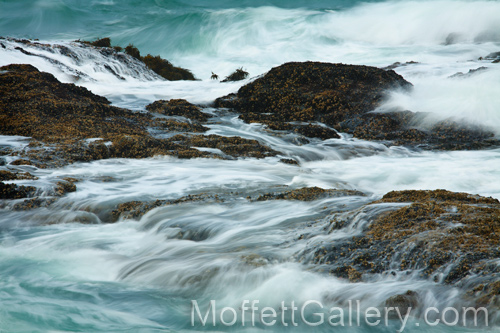
Raging Sea
Yesterday was an interesting day, weather wise. It started out cloudy and windy, which led to my capturing this image just off Ocean View Drive in Yachats. Even though the tide was low, the wind was driving in the waves with such ferocity that the rocky shoreline was quite wild. On a couple of occasions I thought I was safe, and next thing I knew I was soaked and standing in heavy water. It was quite an experience. In this image, you can see one wave approaching while another crashes into the shore and washes over the rocks. On several occasions Christeena got after me for getting too close to the “Danger Zone.” I have a new appreciation for the phrase, “Never turn your back to the sea.” It would have been beneficial to have someone watch the sea while my eye was glued to the viewfinder.
In the afternoon the sun actually came out for several hours. It made photographing much more difficult. The light quality diminished as the sun was directly overhead. When it looked like the sun was here to stay for a while, I decided to take a break. We took the kids up to Seal Rock and strolled on the beach while the sun was shining. It was beautiful, just not real photogenic. I like the softer light that creates more mood and feeling. By evening the clouds had returned and the rain started to fall. It is supposed to rain for the rest of the weekend.
Even with the wild weather, the central Oregon coast is one of my favorite places to visit and photograph. The images that I have been working on this week will soon be available at moffettgallery.com. I will also be posting more here throughout the coming days.
by tmoffett | Oct 7, 2010 | Color, Landscape, Ramblings
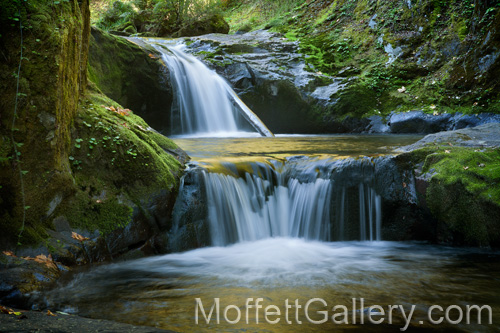
Sweet Creek
After a long drive Tuesday night, we decided to stop in Eugene for the night. We then left Eugene long before sunrise in order to arrive at Sweet Creek, just outside of Mapleton, by sunrise. As we hiked up the creek, we were very glad that we added this into our trip. The light was beautiful and the water flow nearly ideal for photography. This is just one of the many images I was able to create before the light became harsh.
I love photographing moving water. I think that is what draws me to the ocean. When I can’t get to the ocean, I search for rivers and streams. Long shutter speeds, soft moody lighting and moving water make me happy! I can feel it, this is going to be a good week, but then any week on the Oregon Coast is going to be a good week.
by tmoffett | Oct 5, 2010 | Color, Landscape, Ramblings
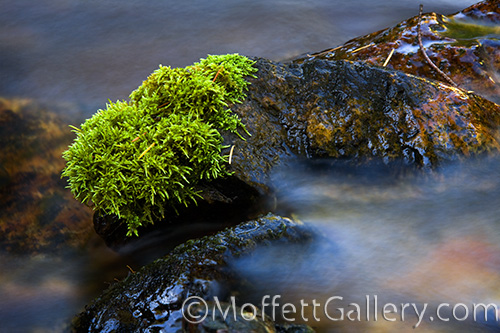
Rocks and Water
Detail photographs can be a great addition to a portfolio to add some variety. I often look for the one great shot and forget to look at the details. You may find that the best image lies within the frame that you have already shot. I like to start with the wide, establishing shot and then work down to the details. Such was the case here. I went from using a 20mm wide angle lens to my 200mm telephoto lens, and it was then that this small stream seemed to come to life for me. The water flowing around the moss covered rocks were inviting me to come closer. And when I did, I was not disappointed. The water seemed to make what color I found in the rocks to come to life. Almost animated. It was a wonderful experience to photograph.

Recent Comments