by tmoffett | Jul 22, 2010 | Color, Composition, Landscape, Photographic Philosophy
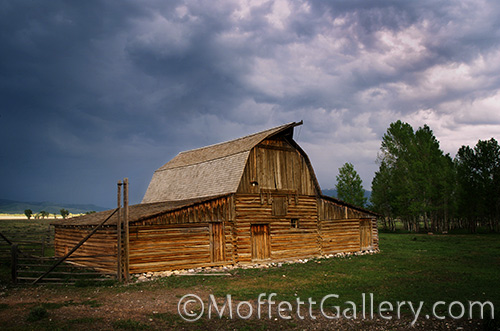
Old Barn near Jackson Hole, WY
Why is it that landscape photographers are drawn to old barns? I normally like my landscapes clean, but when there is an old barn in the scene, I will photograph it. All other man made objects or structures I want removed, but an old barn can stay.
I happened upon this barn just as the rain passed and I was able to watch the sun set while I photographed. The nice, soft, warm light of the setting sun with the storm clouds overhead made for a very nice composition. That is one thing that I try always to be aware of when shooting. What is the sky doing? If the sky does not enhance the image, then how can I minimize it? In this case, I love the sky, so I made sure to include it in the image. Remember, the background, in this photo, the sky, can make or break the photograph.
by tmoffett | Jul 18, 2010 | Color, Family, Photographic Philosophy
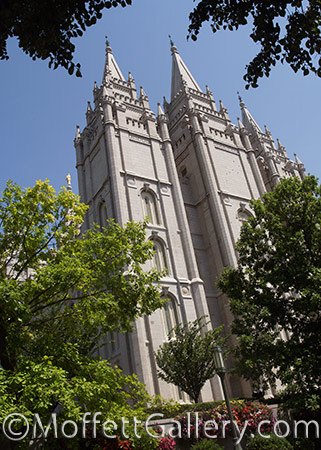
Salt Lake LDS Temple
I love the song Photographs and Memories by Jim Croce. This photograph is one that brings back great memories for me. It is where Christeena and I were married over 20 years ago. We have had a great life together and I look forward to an eternity of happiness with her!
Making photographs is one way that we keep memories alive. Not every photo is a masterpiece or a work of art, nor need it be. Often, as a photographer I have a hard time taking “snapshots” because I have it in my head to make every shot count. I slow down and think too much when I should be shooting away, and before I know it the moment is gone. For this reason, Christeena takes most of our snapshots. I need to change. There is a time and a place for the artwork, and a time and a place for snapshots, and I need to learn the difference.
Sometimes a photograph can create great memories and be a piece of art at the same time. This image was created years after our marriage while on a family trip back to the Salt Lake area. While helping the younger kids at a drinking fountain I looked up and saw this image. I had wanted to make a photo of the temple that was different than all of the others I had seen, and this just happen to be the one. Fortunately I had my serious camera with me and I quickly set up and made the image. A 20×30 print hangs in my house as a reminder of that wonderful day more than 20 years ago.
by tmoffett | Jul 17, 2010 | Black and White, Landscape, Photographic Philosophy
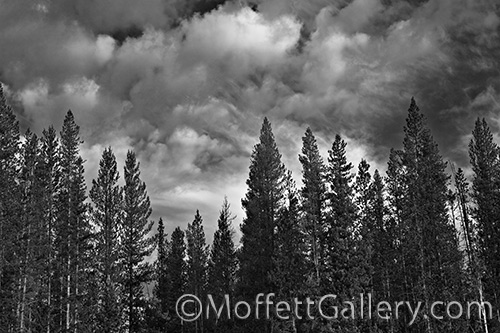
Cloudy Skies
I love the edges. The edge of the light. The edge of situations. The edge of a storm. It seems that everything is more exciting on the edge. Buried in the center is predictability. The light becomes lifeless. The storm is dark and wet. On the edge of a storm you will find clouds that are lively and exciting.
This image was made a couple of years ago and I haven’t been to excited about it. I finally, after passing over it numerous times, decided to print a small print. I do that as I prep images to see the progress and make sure everything is perfect before doing the final, master print. When the 7×10 came out of the printer my heart immediately jumped! the clouds popped and I was hooked. This image definitely has potential. It still needs a bit of work, but it will get there. My process for getting to the master print is a long one. I have in my minds eye a good idea as to what the print will look like when I shoot it. However, I tweak the image and refine it over a period of time until it is just right. Sometimes this takes hours, sometimes days and sometimes weeks. It just depends on the image. But when it is finished, it is just right. It will have a feel to it that sens a message to the viewer and hopefully let them feel what I felt when it was created.
by tmoffett | Jul 13, 2010 | Black and White, Composition, Landscape, Photographic Philosophy
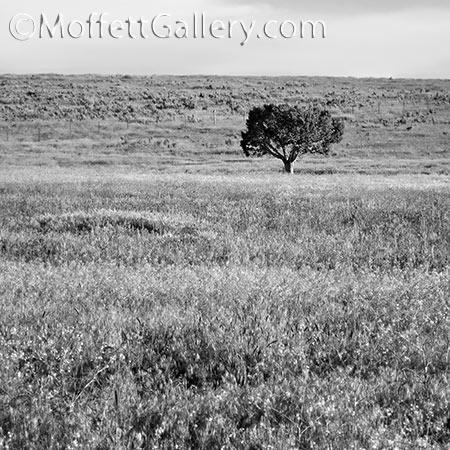
Isolation, Cassia County, Idaho
Composition in landscape photography is sometimes a touchy subject, but in my opinion is very critical to discuss. Some see good composition naturally… it is a gift they have, others must learn to see. Neither way is necessarily better than the other, just different ways of seeing. I often hear that “rules were meant to be broken.” Yes, but I also once heard that “knowing the rules and intentionally breaking them is the difference between art and accident.” We must understand and recognize good compositional design.
The first basic rule of composition that I each is the Rule of Thirds. It is a simplified derivation of the Golden Mean. This basic rule will do more to improve your photography than any other rule of composition. In a nutshell, what it states is that if you divide your frame into thirds both horizontally and vertically, the strongest points to place the main subject matter is on one of the intersecting points. Basically, avoid centering the subject. At first this may seem odd, and sometimes difficult as you must also maintain visual balance, but as you practice and develop an eye for better composition, it will become very natural.
In this image, if we were to overlay a grid dividing the photograph into thirds, you would find that the intersection of the top and right third lines is right over the tree. There are some other compositional elements at play in this image that help it as well, but the main one is the Rule of Thirds.
Oftentimes we get in such a hurry to get the shot that we forget to really scrutinize what is in the viewfinder. Slowing down and checking every square millimeter of the viewfinder will help us to eliminate everything that distracts from the subject, thus allowing a more simple and powerful image. It is my philosophy that slowing down will allow me to get one really great photo, which is much better than coming home with ten mediocre images.
Slow down, check and recheck the viewfinder and apply the rule of thirds and you will notice drastic improvements in your images.
by tmoffett | Jul 10, 2010 | Color, Landscape, Photographic Philosophy
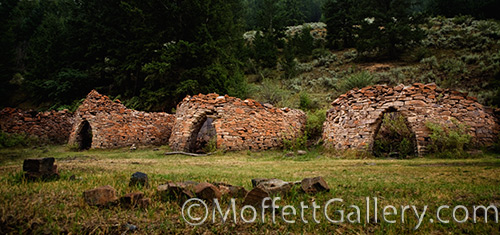
Abandoned Kilns
As a landscape photographer, I don’t find myself drawn to structures very often, however on a trip to the old ghost town of Bayhorse, Idaho, we passed these old abandoned kilns and I had to stop. I have since thought about why I needed to stop. What is it about ghost towns that we are drawn to?
Bayhorse was a booming mining town in the 1880’s and 1890’s. these kilns, along with 3 others are where charcoal was made to fuel the smelters. I can imagine these in full operation. It was a very busy place. And now, nothing. Empty. Only a figment of our imaginations.
It is amazing to me how a place can be so full of life one day, and totally deserted the next. The emptiness is what I felt as I pondered what I was photographing. That is what I wanted to portray. I think it shows. I know I feel it again when I view the image. The soft light coming from an overcast sky helps create the feeling, as well as the darker, moodier interpretation of the final print. The rocks in the foreground also enhance the feeling of abandonment and decay. I hope you can feel it as I do.
by tmoffett | Jul 9, 2010 | Architecture, Color, Critique, Photographic Philosophy
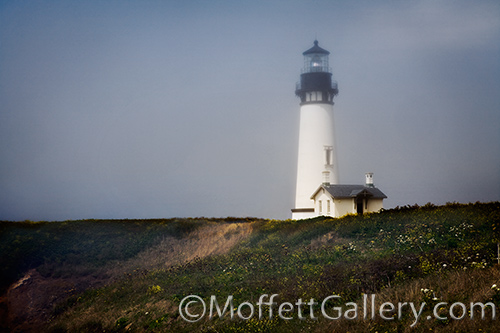
Yaquina Head Lighthouse
I don’t know what it is about this image. I initially didn’t think too much of it, but every time I have reviewed the set of images from my Oregon Coast 2009 trip, this one stands out more and more. It is kind of growing on me, I guess.
I have found over the years that certain images will really appeal to me initially, and over time kind of fade away, and others will take time to grow on me, but I seem to never tire of them. For this reason, I always do an initial edit of my work, but review it several time over the course of several months or even years. Often I find little gems that I missed at first. This is one of those.
When I was at Yaquina Head, the fog was rolling in from the sea and you could barely see the top half of the lighthouse. We hiked down to Cobble Beach and occasionally the fog would grow thin and you could see the top, however it left a unique softness to the image. I think that is what is drawing me in. The subtle color and softness create a very passive feeling, very relaxing to look at. It is very different from the stark, crisp and sharp architectural images that we are used to seeing. I kind of like it for a change.

Recent Comments