by tmoffett | Aug 23, 2010 | Color, Composition, Landscape
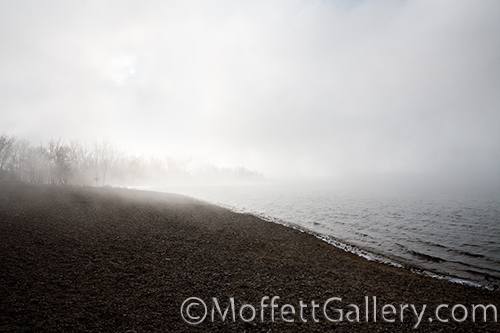
Foggy Morning, Lake Lowell
Combining the concept of simplicity and the design element of line in landscape photography is sometimes difficult for new photographers to grasp hold of. Often, I find students using line in predominantly “busy” images, which is just the opposite of simple. I love combining these two because when done successfully you end up with a very calm, peaceful image that has good flow or creates good eye movement throughout the photograph, as with the image above.
by tmoffett | Aug 17, 2010 | Color, Composition, Landscape
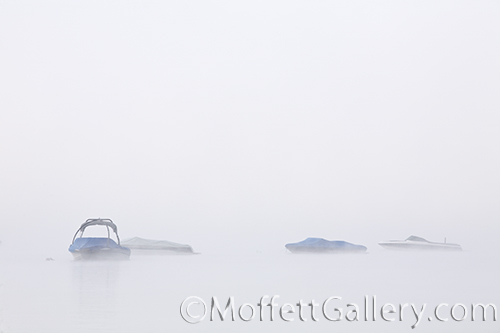
Summertime Fog, Redfish Lake
Had to post another image from last weeks trip to Stanley, Idaho. It was such an unusual look for this time of year. The simplicity of the scene created by the fog, as it minimizes the contrast and the background distractions was captivating. I am always looking for simplicity in my images as that is what I am. Just a simple photographer living a simple life. The concept of “less is more” really works here. It is a hard concept to teach, but when mastered is very effective.
by tmoffett | Aug 8, 2010 | Architecture, Black and White, Composition
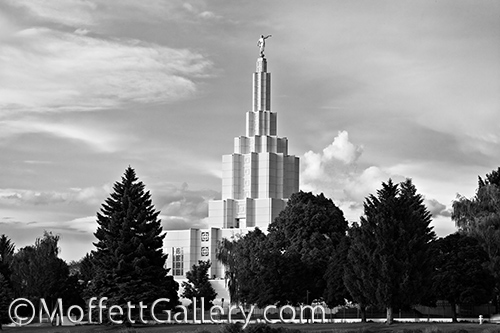
Idaho Falls LDS Temple
When photographing architecture, and especially in black and white, I look for interesting skies. Without clouds, the sky becomes just a boring gray tone. I have just one word of caution, though. If the sky is too dramatic, then it can overpower the building, detracting from the original intent of the photo.
Notice the composition in this image. The building is surrounded by, and rising out of the trees. I have included the landscaping as a way to frame the temple and give the image a solid base. With the sky, I positioned the camera so as to place the spire in a darker part of the sky and surround it with clouds, helping to draw attention and frame the building. The evening light was soft enough to allow detail in both highlight and shadow, yet hard enough and at a low enough of an angle to create depth and dimension in the structure. Light quality, whether natural or artificial, is the key to successful photography.
by tmoffett | Aug 5, 2010 | Black and White, Composition, Portraits
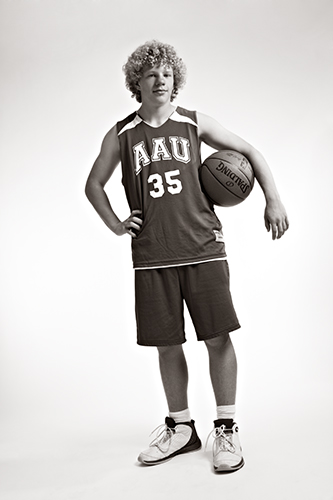
Ben
If you only know me through this blog, you may think that my only subject is the landscape. If so, today may be a surprise for you. My interest in photography began with the landscape, but then I turned to portraits for more than 15 years. I have always loved landscape photography and felt like I could express myself better there than with other subject matter, but I had a family to feed and portraiture and wedding photography is what made that possible. I still do a fair amount of portraiture, but my own personal work is almost always landscape.
You will notice, if you study my portrait work that I believe that simple is better. I feel that way about landscapes and portraits. It is my way of seeing the world. By simplifying a portrait, I am able to more readily make the subject known. It is always about the subject and never about the background. Whether in the studio of outdoors on location, the subject and lighting always take precedence over the background. If the first 2 are good, the background will be fine. Many times I see portraits that are really all about the location, the scene or the background, and the subject just happens to be there. This way of thinking and designing a portrait is backwards. It may be a great scenic image, but when the main subject takes a back seat to the background then it has lost its power. I would rather have nothing in the background than something that overpowers what I am trying to show.
by tmoffett | Aug 4, 2010 | Color, Composition, Photographic Philosophy
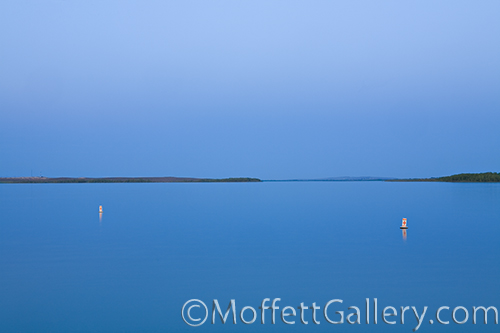
Simply Blue
As a young child we notice everything. Our minds soak up every detail that we see. As we age we tend to ignore most everything, actually seeing less than we ignore. Then we pick up a camera and want to make photographs with impact and feeling. We must train ourselves to see those simple things that we have learned to ignore. In the fast-paced world that we live in, this can be a most difficult task. For me, I must slow down and savor the moment, oftentimes sitting and looking and thinking, taking in everything, the sights, the sounds and the smells. Then I am able to make creative decisions about what it is that I want to portray.
I like simple. I think my photographs, for the most part are simple. Life is better when lived simply. Busyness and confusion are all around us, easy to find and see. Finding the simple is becoming harder and harder, which makes it so rewarding. It is all around us, but we must search to find it. It does not present itself readily because we have learned to ignore it. When found, though, it is like a breath of fresh air, calming and peaceful. My goal in my landscape photography is to find the simple in the crazy and untamed world in which I live.
by tmoffett | Aug 2, 2010 | Color, Composition, Landscape
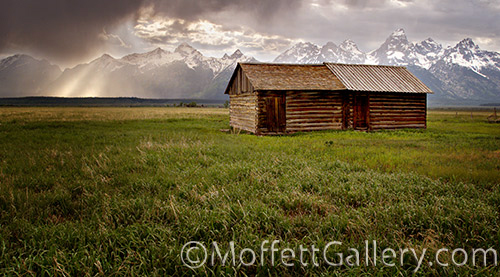
Texture in the Tetons
Texture is an interesting element. It creates detail in a picture that we like to explore. It can create interest where it might otherwise be boring. It can also create busyness that can be a distraction if misused. Simple composition packed with texture is most effective.
I happen to be fortunate to be at the base of the Tetons one evening during some stormy weather. The clouds lifted just enough for the suns rays to penetrate and create just enough illumination for near perfect balance between the foreground and background. The rays themselves make an interesting secondary subject on the left side of the image as well. The light quality is very important, but look at the texture here as well. we have three different kinds of texture at play. First, the foreground, the grasses and foliage are all texture, leading the eye to the log structure which is number 2. Due to its being nearly surrounded by the foreground and its different type of texture, the eye finds it as a resting place. Having a resting place is essential in an image packed with texture, otherwise we bounce from one thing to another and it becomes exhausting to look at.
Our third element of texture is the mountains themselves. By being backlit, the contrast is reduced and the mountains become less dominant, the perfect background. this image is not so much about the the building or the mountains, but more about light and texture, visually a great combination.

Recent Comments