by tmoffett | Sep 5, 2010 | Color, Landscape, Ramblings
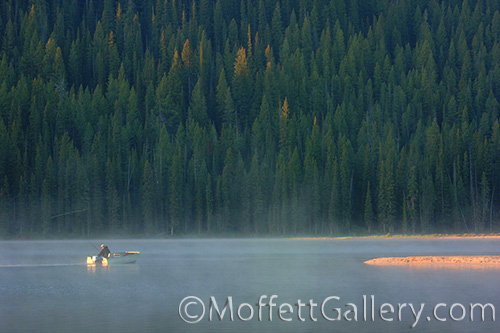
Rising Mist, Stanley Lake
The cool summer mornings at Stanley Lake are quite refreshing. There is nothing better for cleansing the mind and getting a fresh start. It seems that when I get out like this I can put the stresses of life behind me and just enjoy the beauty that this world has to offer. When returning home I am then ready to tackle the challenges thrown my way.
When out in the wilderness, I like to arise long before sunrise to get ready for the day. I will then photograph the sunrise, return to camp to cook breakfast for the family and then spend the day hiking and fishing, making sure to be back about an hour before sunset to photograph again. It makes for a perfect day! I only wish every day could be as good. This particular morning I didn’t even have to leave camp to make this image. The sun had just come over the horizon as this fisherman headed out from the dock. Beautiful morning light and a little mist rising from the water. I couldn’t have asked for much more. Because I stayed around camp, the kids got an earlier than usual breakfast. Everyone were happy campers that morning!
by tmoffett | Sep 4, 2010 | Black and White, Landscape
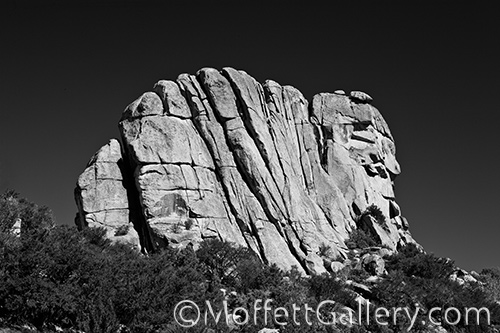
Bread Loaf Rock, City of Rocks
We have some great opportunities for landscape photography in Idaho. City of Rocks is just one of many locations with unique landscape characteristics that make for an exciting morning of photography. This area is filled with rock climbers, as the face of the rocks make for some challenging climbing routes. I prefer photographing without much human element, so fortunately for me, most of the climbers were still eating breakfast while I was out in the field making images.
This image of Bread Loaves was taken just as I was finishing up for the day, and the rock climbers were just starting to find their routes up the face of the rocks. Early mornings, just as the sun rises is a great time for photography, but about an hour past sunrise the light becomes harsh and the scenes have less appeal to me. The soft, moody light diminishes quickly as the sun rises in the sky, and although we can still look and see the beauty, capturing it in camera becomes a greater challenge. The sky, here, was totally clear and cloud free, which made for a simple background for the monolith protruding from the ground. Clouds, I think would have been a distraction.
by tmoffett | Sep 3, 2010 | Color, Composition, Landscape, Photographic Philosophy
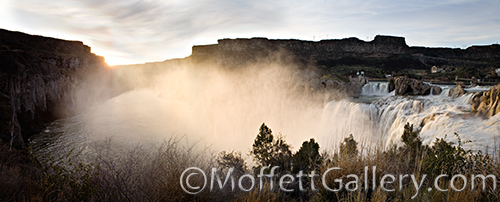
Shoshone Falls
I like using different formats for my photographs. I know some photographers believe that one should always shoot “full frame,” but not me. Why should I let a camera manufacturer dictate the aspect ratio that my photographs should be? I feel that the photographer should be in control of the entire process, including final cropping. When a particular image would be best as a square, then make it square, if rectangle is best, then do that, and sometimes a panoramic format work best. I have shot with a 4×5 view camera quite a bit, but I really don’t like that format full frame. I often will crop the top and bottom 3/4 inch off to make it closer to 3×5. I find that a much more appealing format. I have been photographing that way off and on now for 25 years and I still like it.
One thing that I do believe in is to determine the crop before making the exposure. Previsualization is key. A great photographer will know at the time of exposure what he/she wants the finished piece to look like and knows how to get it. This applies not only to the cropping, but to the final look and feel of the image as well.
Digital photography has changed how I capture images, but it has not changed my vision much. I have had to learn new techniques, but only to the extent of enhancing my vision. The concept of previsualization is a hard one for many of my student to catch on to. With digital cameras offering instant feedback, the new philosophy is to shoot a thousand images and when then when editing, we are sure to find a good one. This thought process destroys the ability to make truly thoughtful art. It is not about creating meaningful images anymore, just pretty pictures. This way of thinking and creating is definitely not for me.
by tmoffett | Sep 2, 2010 | Color, Landscape, Photographic Philosophy
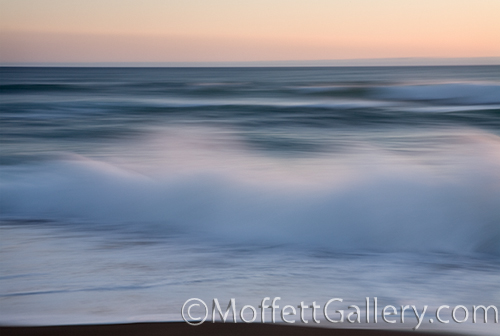
Horizon, Seaside, Oregon
Here is a sneak peek into a new portfolio that I am currently working on. Entitled Horizons, the images are all seascapes made in an abstract sort of way. The power, beauty and motion of the sea are somewhat overshadowed by the horizon line, the only truly sharp area of the photographs.
This series started as a fun diversion from my more traditional landscape photography work. As I photographed more and more, I developed a love for the feeling portrayed in these images. Now, every chance I get to be at the ocean I am there, camera in hand. I have always loved capturing motion with still images, but that love has developed into a real passion while working on this portfolio. There is something very captivating about the ocean. Watching the movement and power of the waves is mesmerizing. I could sit and watch this motion for hours and never tire of it.
The effects of motion in this series is all captured in camera. none of the effects are made in post production. Slight tonal adjustments are the only things accomplished after capture. I am a firm believer in using the camera to make photographs, not Photoshop. To accomplish this task successfully, one must master the technical aspects of the camera, an art that is becoming lost in today’s world.
by tmoffett | Sep 1, 2010 | Color, Landscape, Photo tips
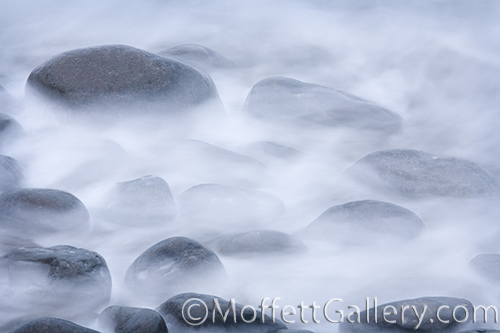
Rock and Water
I love the ocean, and one of my favorite places to visit the ocean is along the Oregon coast. The opportunities for incredible photographs are endless. It makes no difference what the weather is like, imaging opportunities are abundant. The variety of coastline scenery is unreal. You can walk from the sandy beach to tidepools to rocky outcroppings to a rain forest in just a matter of minutes. I don’t think I could ever get bored.
One evening while watching the sun set in the western sky, I began watching the waves wash in over the rocks near the beach. The water would come in and wash over the rocks and then flow back out to the sea. It was quite mesmerizing. As I sat and watched, I turned my lens away from the sunset and began photographing the water. Capturing the motion of the water made the rocks appear soft and pliable. The water became almost a mist, a cloud upon which the heavy rocks floated. Instead of the feeling of hard, heavy, black stones, a light and airy feeling prevailed. I liked that. It emulated my feelings at the time. I was in one of the most beautiful places on the planet, sharing time with my wonderful wife and creating photographs. What could be better?
Not much.

Recent Comments