by tmoffett | Jun 1, 2010 | Color, Composition, Landscape, Photographic Philosophy
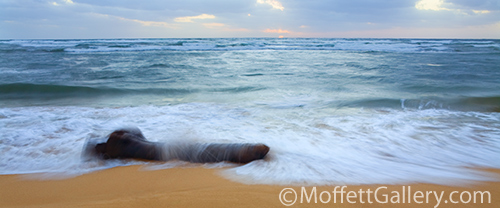
Washed Ashore
This is probably my favorite image that I made on my anniversary trip to Hawaii in January. We were walking along the beach at sunrise and came across this log that had washed ashore and was being beaten down my the waves. It was amazing how a little water could move this big log so violently. I watched and photographed for quite some time… must have shot 20-30 images, all different angles and directions. I loved the motion of the log as the waves slapped up against it. Every shot was different. In this one, the water is wrapping around the log as more water flows over the top, and the rocking of the log is not so violent as in some of the others. The softness takes on a painterly kind of look that is interesting and soothing to me. Again, it is back to my belief that successful photographs are about feeling, and this image has that, at least for me it does. I feet fortunate to have been in the right place at the right time to make this image.
To view more images by Terrell, click here.
by tmoffett | May 31, 2010 | Color, Landscape, Photo tips
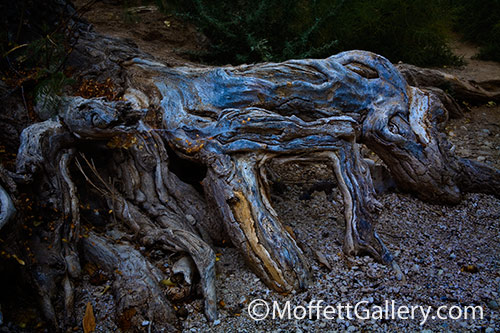
Roots, Lake Lowell
With photography, it’s all about the light. So many times, new students want to go out when there is a lot of light (mid-day) instead of waiting until there is great light quality. When the light is right, nearly anything looks great. My favorite time to photograph is from about 1 hour before sunset until 30 minutes after sunset. There is not much light after the sun goes down, but the quality of the light that there is is wonderful. A tripod is a necessity, but so worth it.
This image was made in complete shade just prior to the sun setting. The light falling on the root system is from the north, so it is open sky, thus enhancing the blue tones that were already in the tree roots. I have never seen roots with the color that this root system had, so I wanted to enhance it even more. The blue light from the open sky did just that. Another advantage of evening light is that it is very soft, meaning that the shadows will be very open and full of detail, something that is impossible with mid-day sun. It allows for very dramatic reproduction of ordinary scenes, rendering them very extraordinary.
More images can be viewed at MoffettGallery.com.
by tmoffett | May 30, 2010 | Architecture, Black and White, Composition, Photo tips
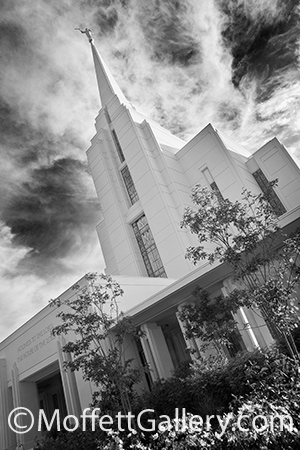
Rexburg Temple
On a trip to Eastern Idaho, I stopped in Rexburg tor a visit some friends, who ended up not being at home. this turned out to be a good thing, as I had a chance to photograph in an area I had not had the chance before. The whole story I mentioned in an earlier post that you can find here. This image is the one I was capturing when I noticed the clouds moving in the other direction.
When shooting architecture, I always look for interesting angles. In this case, I had shot the standard “whole building” shot, and wasn’t at all happy. It looked like something anyone could and would do. I started looking at what made this temple different. It is narrower and taller than most, so I tried to emphasize those characteristics. I came in close, selected a wide angle lens, made sure to compose with the foliage in the foreground to act as a natural frame and then waited for the clouds to move to a desirable location. The resulting image is both pleasing and different. I then turned and headed across the street to photograph the clouds rolling in.
More images can be seen at MoffettGallery.com.
by tmoffett | May 29, 2010 | Color, Family, Photo tips, Portraits

Simple Life
I’m going to break from the landscape images I have been showcasing lately, and post something completely different today. I was looking back through my files the other day and came across this image that I made when testing a new camera a while back. I know, this is just a snapshot of my daughter when she was 2, but there are some good things that we can learn from it. What is it that makes photographs of people, whether it be a formal portrait or just a snapshot, stand out from the rest? Lighting? Background? Cropping? … All of these are very important, however one thing, in my opinion, that we must watch for is the eyes. If the “eyes are smiling” and they are well lit, then they will overshadow some of the other flaws of the image. The eyes are the windows to the soul, and by having them well lit and looking good, we, the viewers, are drawn in to the image.
by tmoffett | May 28, 2010 | Color, Landscape
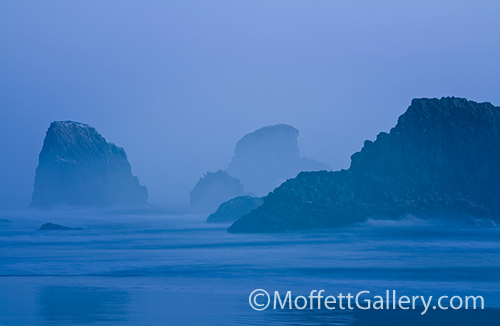
Foggy Evening
Evening light is wonderful! Once the sun sets, you are left with light only from the blue sky, which can be incredible. This particular evening the fog was hanging over the ocean and the blue afterlight left the rocks enshrouded in mystery. It was a wonderful feeling. Completely engulfed in the feeling, I made my best attempt to capture the mystery in this image. I hope you feel the same feeling I felt when I was there.
by tmoffett | May 27, 2010 | Color, Critique, Landscape, Photo tips
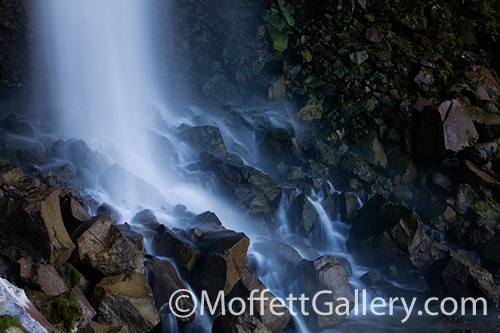
The Falls
In the Spring, when the runoff is at its peak, a trip to Shoshone Falls is a must. While descending to the falls, I noticed this small waterfall off to the side. Thousands of people were down at the main falls, so I stopped here for a few minutes to photograph in solitude. After a creating few images of the whole falls, top to bottom, I just wasn’t happy with where it was going. I stopped and thought about what was really drawing me in, and it was just the base of the falls, the flowing water and the mist. I focused my vision to that, and this is what I came up with. I love the interaction of the water with the rocks. Strong, sharp solid rock and smooth flowing water in the evening light. Life just doesn’t get much better.
by tmoffett | May 26, 2010 | Black and White, Landscape, Photo tips, Photographic Philosophy
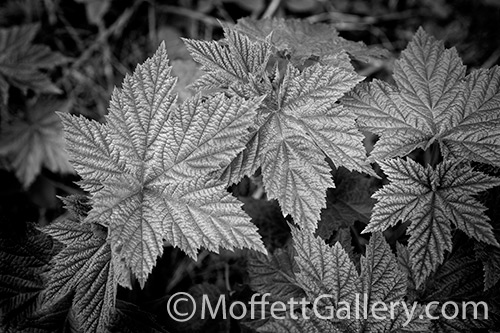
Silver Beauty
It amazes me how many times I hear students say, “I can’t find anything to shoot.” Developing a vision and then becoming aware and truly observant of our surroundings are skills that every successful photographer must have. It takes time and practice to develop these skills. Many mistakes will be made along the way, but from every mistake we can learn, and by learning we become better. The only way to develop your own vision is to get out and make photographs. Often. Daily, or at least weekly whenever possible.
Evaluating your images is the second step to developing vision. Self-evaluation is good, but critiques from mentors and peers is even more effective. We must learn to accept constructive criticism and grow from it in order to reach our potential. We become so involved in our own work that often we fail to see our shortcomings. Even to this day I seek out critiques from my associates. I want to know how my photographs make them feel. What would they do differently?
Silver Beauty is a result of all of the above. I was on a school outing with one of my boys, and I got up early, stepped outside the cabin and found this scene. Just a small leaf, but the light falling on it was wonderful. After making the original print, I asked several of my photographer friends what they thought. I considered their feedback, made a couple of changes and then watched the print go loan at Professional Photographers of America annual print competition.
by tmoffett | May 25, 2010 | Black and White, Landscape, Photo tips
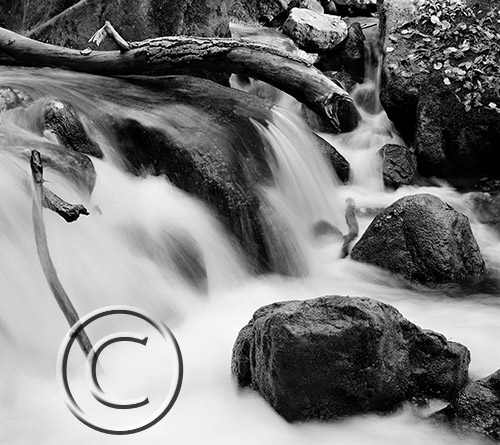
High Creek
Yesterday, as I was writing, I got to thinking about photographs I have made in the past with water. The image posted today, High Creek, is one of my earliest successful photographs of water motion. I guess I have been drawn to water for quite some time, but recently I have become more aware of how much it interests me. I have spent a lot of time on a personal project of documenting Lake Lowell, and I guess that that is one of the reasons I have become more aware and fascinated with the characteristics of water.
I don’t thinks I am alone in this fascination, either. It seems that many of my students love water as well. I am asked over and over how to capture the smooth, silky images of flowing water. The principle is very simple. Use a tripod and shoot with a slow shutter speed. This leads to a perfect assignment for a beginning class, as it forces the students to practice the principle of equivalent exposure. They can see immediately the difference between using a long shutter speed and small aperture and using a short shutter speed with a wide open aperture. Once equivalent exposure is mastered, it seems to open up a whole new world of creativity to beginning photographers.
by tmoffett | May 24, 2010 | Color, Landscape, Photographic Philosophy
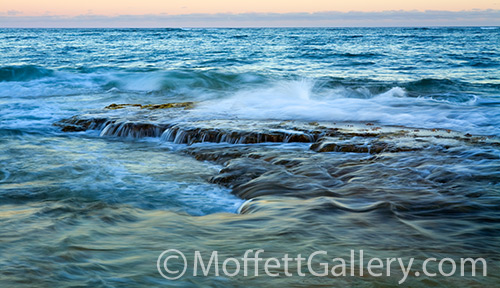
Ocean Waves
Water. Power. Beauty. The motion of water, captured in a still image is a beautiful thing. The past few months have been intrigued with water-land interactions. This image was shot while on a vacation in Kauai in January. We were walking along the beach just outside of our hotel one evening and came upon this reef just offshore. I watched the waves for quite some time, mesmerized by the motion created as they crashed into the reef and washed over the top and flowed softly back into the ocean. I could see the beauty and feel the power of the ocean current.
A photograph, a piece of art is about feeling. Yes, it must be technically executed to near perfection, but without feeling it is only a pretty picture. I want my images to allow the viewer the privilege of feeling what I feel when I am photographing. Ideally I want more than one of the senses involved. With this photograph, can’t you almost feel the mist on your face, smell the ocean breeze, want to reach out and touch the water? What do you feel when strolling along the beach? If a stirs an emotion within you, then it is a successful image.
by tmoffett | May 21, 2010 | Color, Landscape
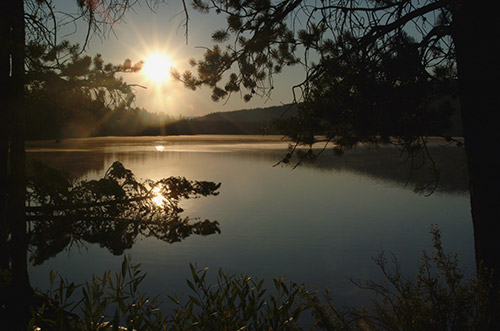
Stanley Lake Sunrise
Stanley Lake is a favorite destination for our family camping trips. The scenery is beautiful and the fishing not bad. I love both, and it just happens that the best time of day for fishing and photography is the same. Needless to say, I struggle with this. Do I take camera or fly rod? Most mornings the camera wins out.

Recent Comments