by tmoffett | Jun 16, 2010 | Color, Composition, Landscape, Photo tips
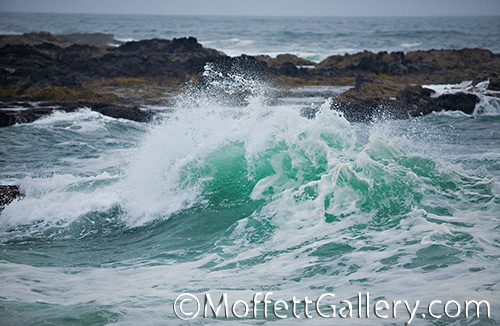
Aqua Wave
Not all of my images of water are motion blurred. Sometimes it is more effective to stop the action. While I was shooting on the ocean, I was drawn in to the color of the water. It was most apparent when a wave would break and there was a little light coming through the backside. The wave would become nearly transluscent and the aqua color very dominant. It was as though the color changed from blue to green for just that instant. Capturing that color was only possible by stopping the motion in the image. Timing had to be perfect as well or the whitewater overpowered the aqua color. I followed wave after wave until this one broke in just the right location to capture the color I was after.
Even thought the motion has been stopped here, the curl of the water and the strong diagonal composition still leave you with a sense of motion. Also the shallow depth of field help to isolate the wave against the background, something that with a longer depth would just not happen. The background would become a distraction instead of an enhancer that it is here. I like the feeling that the wave is right on top of you, like it is going to jump out of the frame and get you wet.
by tmoffett | Jun 12, 2010 | Color, Family, Landscape, Photo tips, Photographic Philosophy
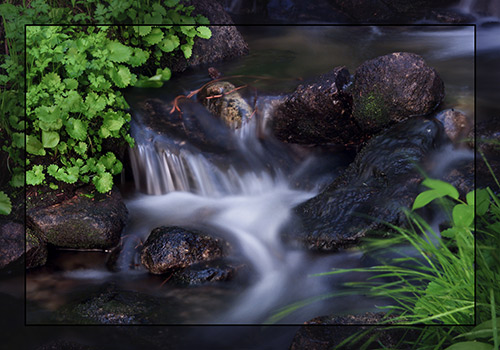
Mountain Stream
As great as it is to be away, it is always good to get back home. I haven’t had a chance to even look at what I shot yesterday on our way home, as we got in about 2:00AM and I was too tired to even look at them, so I am posting an earlier image from my archives today. I will be posting more images from this trip in the future, so come back often!
I mentioned that we got home at about 2:00AM, and we almost didn’t even get home at all last night. We came back on Hwy 26 through central Oregon, stopping along the way to photograph. It is a beautiful drive, and I would highly recommend it. We gassed up in Eugene, thinking it would be no problem getting gas along the way. I had no idea how hard it is to find gas in Oregon after 8:00. When the stations are closed, the pumps are disabled so you can’t even purchase gas with a credit card. Anyway, the low fuel warning came on in Vail, and we made it to Ontario on fumes and found a station open there, so thankfully, we didn’t have to spend the night in the truck on the side of the road.
This image, Mountain Stream, is an Idaho photograph, shot some time ago. I have been intrigued with the motion of water for a long time. Water is powerful, however it also has a very delicate side to it. The soft flow as it winds itself down the mountainside in the evening light creates a calm and peaceful feeling. I love black and white, however in this image, I feel that using the green foliage to frame the rocks and stream were really powerful. The color has a purpose here. If there is no purpose for the color, in other words, if it does not add to the image, then I keep it black and white. I am a strong believer that every element in the image should add to the effectiveness of the final piece of art. If it does not, then it should be somehow removed.
To see more of Terrell”s photographs, see MoffettGallery.com.
by tmoffett | Jun 10, 2010 | Black and White, Landscape, Photo tips
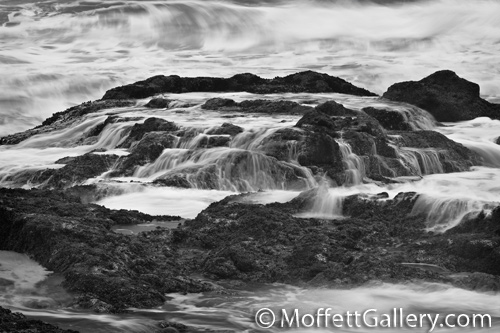
Angry Sea, Yachats, Oregon
Yesterday was a very wet day on the Oregon coast. We had rain and angry seas all day. After a trip to the Marine Science Center in Newport, hoping that it would dry out a bit, we headed to the Bayfront to check out some galleries. Still raining, so went went to Mo’s for lunch. While waiting for our meal, the rain stopped, for a minute. We decided to head south. We stopped at Seal Rock, a very interesting place when the light is right, but not today.
Driving through Yachats, we found a place where the waves were pounding into the rocks and creating quite a scene. The whole day the sea had been rough, and this was a perfect place to illustrate that. I climbed out on the rocks and started photographing, and then the rain came again. Trying to keep the lens dry was a challenge, and I lost a couple of pretty good images due to water on the splashing on the lens. The sky was pretty dull, so I tried to keep it out of the frame. The wave rolling in made a much more interesting background, as you can see here. Timing on this image was a challenge as well. Getting the waves rolling in the background at the same time as the water from the previous wave was washing over the rocks and back into the ocean was tough, but did happen just right on occasion.
This is an example of a time when many would give up because it is wet and cold and miserable. I have seen it many times. I am so glad that I did not give in yesterday. When a challenge arises, conditions maybe not optimum, I have found that if I reach into my heart go out with determination I can still create meaningful photographs. Persistence will always pay off.
More images available at MoffettGallery.com.
by tmoffett | Jun 7, 2010 | Color, Composition, Landscape, Photo tips
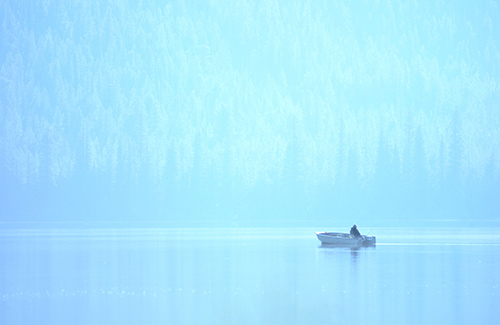
Through the Mist
I remember distinctly when I shot this image I knew I had a keeper. The sun was just coming over the horizon and the mist was rising off of the water. Just at the right moment this rowboat showed up in just the right spot. Everything was working for me that morning. This is one of my favorite images of all time, and I really didn’t have to work very hard to get it. I just had to be there and recognize that the image was right before my eyes. That, oftentimes is the hardest part of photography… recognize. We must train our eyes to see. If we can’t see a good image, we will never be able to photograph one.
How do we train ourselves to see? Study. We must look at images. Lots of images. Not just photographers, either. Search out other artists that do the kind of work that interests you. Analyze their work. How is it lit? What elements of composition are used? What is it that draws you into their images? After looking at lots of work, then go out and shoot your own images, then analyze them. Look at more images, shoot more, analyze more. As you do this, you will find yourself improving. As you improve, it becomes even more enjoyable.
More images at MoffettGallery.com
by tmoffett | May 31, 2010 | Color, Landscape, Photo tips
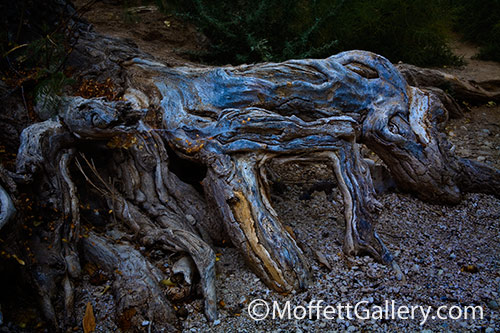
Roots, Lake Lowell
With photography, it’s all about the light. So many times, new students want to go out when there is a lot of light (mid-day) instead of waiting until there is great light quality. When the light is right, nearly anything looks great. My favorite time to photograph is from about 1 hour before sunset until 30 minutes after sunset. There is not much light after the sun goes down, but the quality of the light that there is is wonderful. A tripod is a necessity, but so worth it.
This image was made in complete shade just prior to the sun setting. The light falling on the root system is from the north, so it is open sky, thus enhancing the blue tones that were already in the tree roots. I have never seen roots with the color that this root system had, so I wanted to enhance it even more. The blue light from the open sky did just that. Another advantage of evening light is that it is very soft, meaning that the shadows will be very open and full of detail, something that is impossible with mid-day sun. It allows for very dramatic reproduction of ordinary scenes, rendering them very extraordinary.
More images can be viewed at MoffettGallery.com.
by tmoffett | May 30, 2010 | Architecture, Black and White, Composition, Photo tips
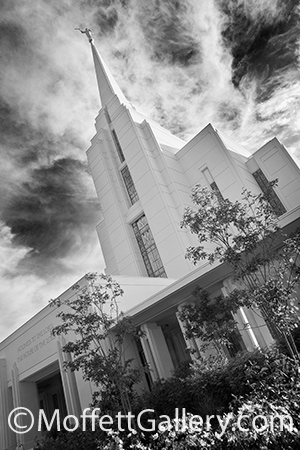
Rexburg Temple
On a trip to Eastern Idaho, I stopped in Rexburg tor a visit some friends, who ended up not being at home. this turned out to be a good thing, as I had a chance to photograph in an area I had not had the chance before. The whole story I mentioned in an earlier post that you can find here. This image is the one I was capturing when I noticed the clouds moving in the other direction.
When shooting architecture, I always look for interesting angles. In this case, I had shot the standard “whole building” shot, and wasn’t at all happy. It looked like something anyone could and would do. I started looking at what made this temple different. It is narrower and taller than most, so I tried to emphasize those characteristics. I came in close, selected a wide angle lens, made sure to compose with the foliage in the foreground to act as a natural frame and then waited for the clouds to move to a desirable location. The resulting image is both pleasing and different. I then turned and headed across the street to photograph the clouds rolling in.
More images can be seen at MoffettGallery.com.

Recent Comments