by tmoffett | Jun 29, 2010 | Color, Landscape, Photo tips
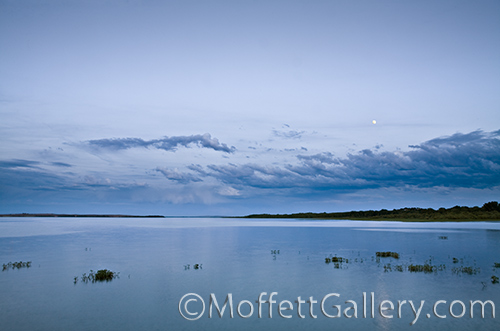
Moonlight, Lake Lowell
Just about when everyone else packs up and leaves because it is too dark, I begin my quest for a great photograph. I love shooting after the sun has set. Some of my best images were 20-30 minutes after the sun has gone down. The light is wonderful. The only problem is that there is not very much of it, so you must use a tripod.
On this evening, I was out with Christeena and we also had our 11 year old son with us. We had picked him up from his Boy Scout meeting and went directly to the lake. He was not very excited to be there, and when he kept hearing me say, “Just one more…this is the last one,” and then I would see something else and have to shoot another image. Both he and Christeena had packed up and were in the truck waiting for me as I continued shooting.
This image was shot well after the sun had set. The moon is rising over the lake and there is still enough light in the sky to get good definition in the clouds. I love the blue color. The color is due to everything being lit from the sky. There is no more warm sunlight, just the sky and moon to provide illumination. The image is very simple. That is the strength of it.
by tmoffett | Jun 27, 2010 | Color, Landscape, Photo tips
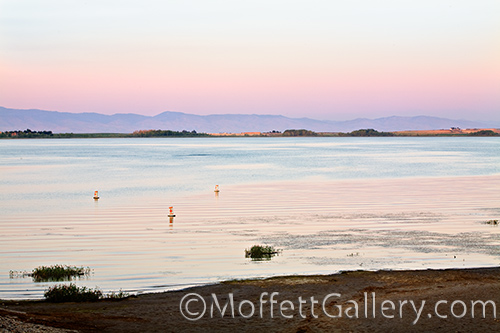
Pastel Sunset
There is a saying among photographers that goes something like this: “If you like the light where you are shooting, turn around and look the other way.” I can’t remember when or where I first hear that, but it is some of the best advice I have ever received. It is so easy to become engrossed in what we are doing that we fail to look around and find something even better. This image is an example of this concept being put to use.
I was photographing a great sunset one evening while out shooting for my series on Lake Lowell. I was completely focused on what I was doing. This was to be one of the best images in the series. Then I heard a voice within myself say, “turn around, turn around.” I looked up for a second, turned my head and saw this. Beautiful pastel colors in the sky and reflecting across the lake behind me. I had never seen these colors on the lake. It seemed as though the image was handed to me on a silver platter and I nearly refused to take it, not because I didn’t like it, but because I didn’t see it!
A great photographer will always be aware of his/her surroundings. He will look at all angles and directions in order to capture the best possible image. He will be aware of the light and learn to see the subtleties in its quality. He will become one with the environment.
by tmoffett | Jun 26, 2010 | Color, Landscape, Photo tips
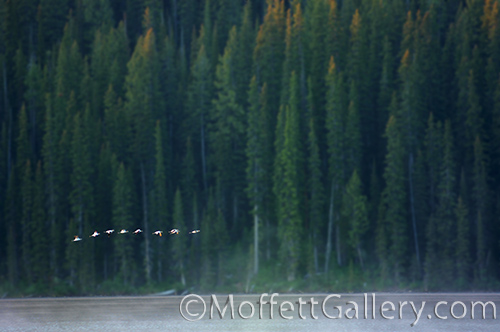
In Flight
Ever feel like you’re going in circles and never going to get ahead? I know I have, many times! Moving from one problem to the next without any forward movement at all. That’s what I thought of when I woke up one morning while camping at Stanley Lake in the Sawtooth Mountains here in Idaho. These birds were circling the lake, round and round for no apparent reason. I guess they were working out, kind of like running laps around a track, or else protesting NASCAR because they were turning right instead of left! It was an interesting sight, none the less. I thought there was no way I would have time to get my camera and document the event, but they kept on racing for quite some time. I broke out the camera and was able to get off a number of shots as they circled the lake. In this shot, it is quite amazing how the wings of the birds seem to be synchronized. They flow from front to back in a fluid motion. It was perfect. The trees, slightly out of focus help the birds stand out and become the focal point of the image. This is done by selecting a wide aperture, in this case f2.8. This creates shallow depth of field, allowing only the line of birds to be in crisp focus. I was lucky, as well to have a nice mist rising off the water. It seemed that everything was in my favor that morning. I wish it always happened that way!
by tmoffett | Jun 23, 2010 | Color, Landscape, Photo tips
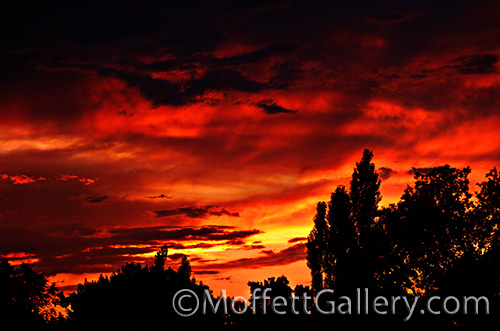
Sunset Silhouette
As a landscape photographer I am always watching the sky. An interesting sky can really add to an image. Sometimes it is the image. Such is the case here.
Something I have learned through the years is to always be prepared. If you don’t have your camera, you can’t make the photograph. I was on vacation, staying at my brother-in-laws house when I stepped out on the balcony and saw this incredible sky. Fortunately I had learned to keep a camera with me. I quickly set up and captured this scene.
When photographing the sunset, one tip is to make sure to not overexpose the image. Your in camera meter will ofttimes tell you to do just that. You must be in control and tell the camera what to do! To get really rich colors, I will often reduce my exposure by one to two full stops. That will also create the silhouette in the foreground which helps to simplify the composition. I am often asked if I manipulated the color in this photo, and the answer is no. It was all done in camera. Shooting the scene correctly will allow you to print larger and higher quality prints. The more you manipulate an image in Photoshop, the more degradation that occurs to the image, thus reducing the overall quality of the finished print. That is why it is so important to master your camera before learning Photoshop.
by tmoffett | Jun 21, 2010 | Color, Landscape, Photo tips
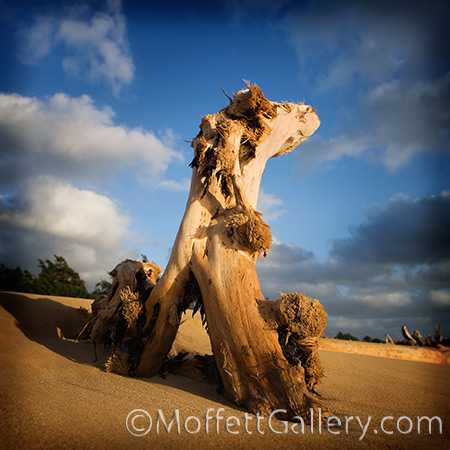
Washed Ashore
I began photographing this log that had washed ashore as an example of an assignment I give some of my classes. I have the students find a subject and make at least 30 completely different images of hat subject. I want them to look at different angles and lighting. High, low, left, right, front lighting, back lighting, early morning, afternoon, etc. After about 20 images I really started having fun looking for new angles. I ended up with about 50 shots to pick from. I had close-ups of the water dripping from the decayed wood near the base, images of the 10 foot log that is hidden on the backside of this end, shots from eye level that show this in its true size (it is actually less than 3 feet tall), wide shots that de-emphasize the log and many other options.
This is a great exercise in vision. It helps develop vision in the beginner as well as keep the seasoned pro sharp. Any time I start feeling a little flat in my work, this exercise helps to get me out of the rut. It is even more effective when you do this exercise with another photographer and then critique each others images. Learning to see and developing your personal vision is vital to becoming a successful photographer. There is so much technical stuff in photography that we can easily get caught up in that we forget to let our feelings and instinct get involved in the process. If we can’t get to that point-letting feelings into our image making, then our photos will be lifeless. I really saw that happen in the series of photos that led up to this one. I was at first thinking about getting 30 images that I was thinking too hard. After about 20 shots I began to just go with the flow, whatever I felt I shot. That is when the “good stuff” began happening. I was no longer thinking about the technical things, they were taking care of themselves (comes from many rears of shooting!). I was having fun composing in the viewfinder, watching the waves and timing them as I waited at beach level to shoot another shot, moving around the log and looking from different directions, watching how the clouds moved and framed the log as I moved positions,…
This is what photography is all about. Having fun and sharing my vision of the world with others.
by tmoffett | Jun 19, 2010 | Black and White, Landscape, Photo tips, Uncategorized
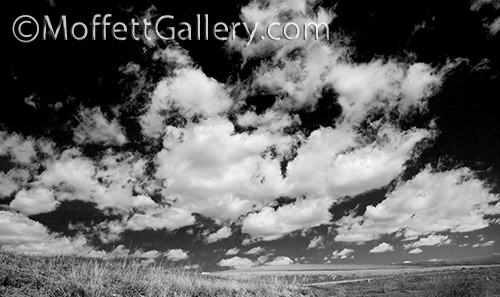
Winder Reservoir
I love going to new places. I was out with some friends a while back over in South-Eastern Idaho and we decided to find somewhere to go fishing. We ended up at Winder Reservoir mid morning and wet our lines. The sun came out and it got hot and the fish were not biting. I decided to get out the cameras and make photographs. The light was pretty harsh, so I focused on the clouds that were drifting by. I have found that during the day when lighting is less than ideal, the clouds often look wonderful. That was the case that morning.
I also love black and white. In my formative years in photography that is all I shot. Very rarely did I even consider color as an option. This was an ideal time to load the camera with black and white film, put on Wratten 25 filter and shoot away. The trouble was I had no film camera with me. So I shot away with my Canon 5D, visualizing what the image would be in black and white, then when returning home converting the original color to the pre-visualized rendering of the image. By minimizing the foreground and emphasizing the sky and clouds, I was able to create a visually pleasing image in the harsh light of the late morning sun.
Photogaphs can be created any where and anytime. We just need to know where to look. Recognizing what we can do in different lighting conditions is a skill that takes much practice. I am still learning. Shooting and evaluating are both necessary to learn this skill. Many times we forget the evaluation step, but without it we will keep doing the same things over and over and never learn. Take the time to review what you do. Show others and get feedback. That is what really helps.
Happy shooting!

Recent Comments