by tmoffett | Jul 21, 2010 | Color, Photo tips
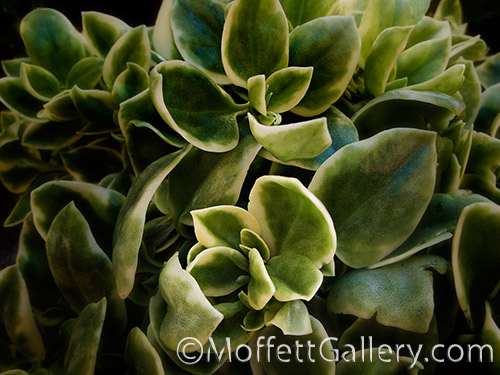
Untitled
I very rarely photograph in the middle of the day. The light is harsh and direct. I have to work too hard to control the midday light, so I just don’t do it. However, I took some students on a field trip one day, and it just happened to be during the midday sun. What do you do? I look for smaller subjects, the landscape within the landscape, or as I like to call them, intimate landscapes.
This small plant I found just outside one of the buildings on the Boise State University campus. It was in total shade, but had a little bit of light being reflected on it from a pillar at the entry to the building. This soft, directional light is just what was needed to highlight the tips of the leaves and maintain good detail in both highlights and shadows, something that is near impossible to do in the direct sunlight at noon.
With smaller subjects, it is quite easy to block the direct light and create a soft directional reflected light. Some things that I have done in the past is to block the light with my own body, and often times if I am wearing a light shirt, that will reflect just enough light to do the job. Other times I will use a piece of mat board to provide the shade. Black foam core is a great tool to keep on hand for these situations. By blocking the light with black and bouncing in some light with white foam board you can gain total control over the light.
Remember, photography is all about the light. Learning to control and manipulate the light will give you a creative edge over those who can’t. It will most certainly open doors for creativity that would otherwise remain closed. It is one way to take your work to the next level and separate you from the amateurs.
by tmoffett | Jul 19, 2010 | Black and White, Landscape, Photo tips
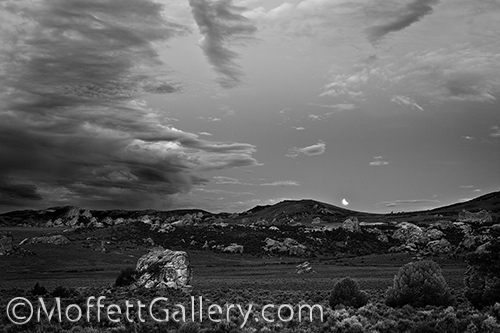
Partial Eclipse, City of Rocks
Three weeks ago I was with some friends at City of Rocks. We had a wonderful time photographing and socializing. About an hour before the sun rose over the mountains the moon, in a partial eclipse was about to set over the western horizon. It was a beautiful, quiet morning, and just soaking it all up was worth the drive. Photographing it was even better. I didn’t have much time to scout location, as it was dark out and I had never been here before, so I took what I was given. The foreground was dark, but the sky was turning out to be quite nice. I had the headlights of the truck to skim across the foreground and throw just enough light to brighten up the brush and the nearest rock formations. This helped create the balance that I needed between foreground and sky.
When mixing light sources like this, be careful. The color of the light from the truck lights is so different from the natural pre-dawn light in the rest of the scene that if you want color, it will be very difficult to correct it. That really didn’t matter to me because I knew from the start that this would be black and white. I just needed light, I didn’t care about what color temperature it was.
by tmoffett | Jul 14, 2010 | Black and White, Composition, Critique, Landscape, Photo tips
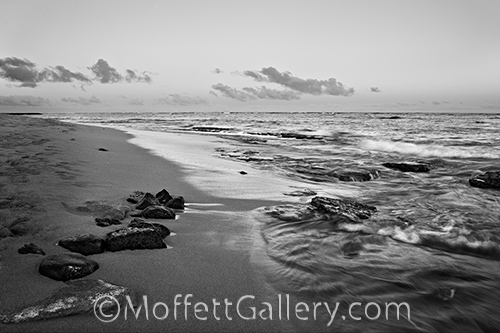
Kapaa Shoreline
Now that we all shoot digital cameras, I think many have forgotten that black and white is even an option. We are shooting color because that is what the camera does. We shoot color for colors sake, and often forget about light quality and tonal range of the image that we are creating. Often, I see images where the color actually gets in the way of the photograph. Toss out the color and the image improves. The photograph above is just such an example, in color, it was very busy. Yellows and reds on the beach, pink and blue in the sky, greens and blues in the water. The placement of the colors just didn’t work, but the tones of the scene were very nice. Learning to see the tones instead of the color is what will make a great black and white photographer.
Shooting for black and white is an art in and of itself that when mastered will dramatically improve your color photography as well. In order for an image to be good in black and white we must look at the tones of the scene. How light is the lightest area and how dark is the darkest area. Morning and evening light, often referred to as the sweet light or the golden hour, give us a reduced contrast and softer light so that detail can be maintained in both highlight and shadow. These are the times of day when I do most of my serious photographing. The light is exciting and most anything will look good.
This image was shot just prior to sunset on the beach in Kauai. The light skimmed across the waves so as to create very nice highlights in the moving water, yet allowed the shadow areas to go dark and rich while still maintaining some detail. Also, as I discussed yesterday, the rule of thirds is used here. I was not consciously thinking about it, but having developed an eye for composition, it just happens. Notice when a grid is placed over the photograph, where the intersecting points fall. 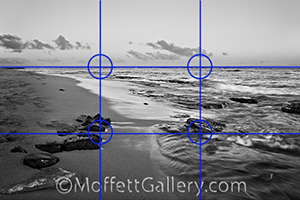 On the rocks to the left, the reef on the right and also the horizon line is on the top horizontal grid line.
Practice shooting black and white and apply the principles of composition and watch your photographs improve!
by tmoffett | Jul 7, 2010 | Color, Photo tips, Random images
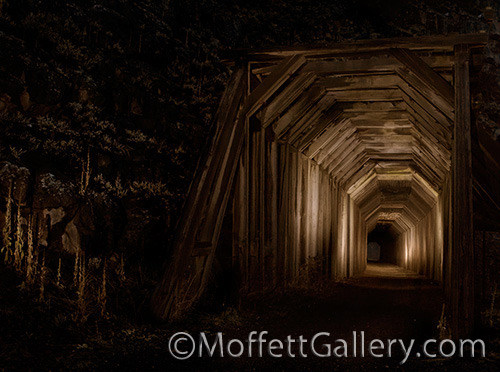
Tunnel Vision
This image brings back great memories! I was with a couple of friends out photographing in Eastern Idaho and we hiked down to this tunnel. It was light when we arrived and the scenery in the area was great. We shot until dark, and then some more. We then realized that none of us had flashlights and it was pitch black. No moon out and away from the lights of the city. We stumbled our way out and finally made it back to the truck. It would have been quite funny to watch us. It was all worth it, though. I also learned to keep a light with me at all times, because you never know when you might need it.
Back to the image. As it was getting dark, the tunnel became quite interesting. I could see a faint light at the other end and the wood trusses created an interesting pattern. The only light available was my Canon 580EX camera flash. I decided to send one of my friends into the tunnel and pop the flash. I ran a test and determined where and with what power to use the flash, then I locked the shutter open and we went to work. We used 8 flashes inside the tunnel and when my friend returned we popped the landscape twice, skimming the light across the surface instead of blasting the light directly into it. In all, the exposure was about 3.5 minutes.
Learning to use and control the light that is available to you is very important as a photographer. It will allow you to make creative images in places and at times that others cannot because they lack the necessary knowledge and skill. It will open new doors for you to explore, and if you are at all like me, you like exploring new ideas.
by tmoffett | Jul 6, 2010 | Color, Composition, Landscape, Photo tips
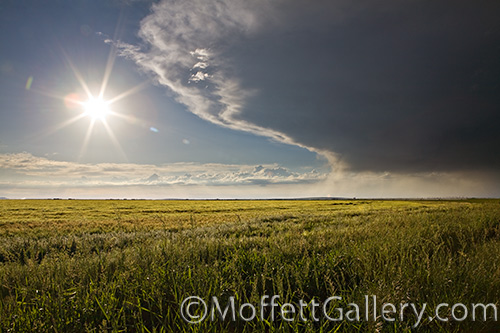
Approaching Storm
I have always taught my students that photographing on the edge of the light is always best. Then the other day, John Paul Caponigro made a comment on Facebook relating to photographing on the edge of situations. It made me think, “Am I missing something here?” I believe I was.
Look at the approaching thunderstorm in this image. Where I am? On the edge. I have been able to capture the beauty of the storm, partially due to the fact that I am also using interesting light. What happens as you get caught in the middle of the storm. I did a few nights ago, and I tell you it wasn’t as pretty as this! The light goes away, it is dark. There is no direction to the little bit of light that there is, so it is flat and dark. Double whammy. Oftentimes wet and miserable as well.
As I look back at past images as well as events that I have covered, I have found that the best images usually do come from the edges. Don’t neglect completely the center, but do make sure to at least explore the edges, you just might find your next masterpiece there.
by tmoffett | Jul 5, 2010 | Color, Landscape, Photo tips
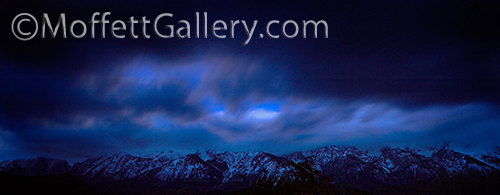
First Light
When in the morning do you begin photographing? Many photographers wait until the sun rises. I, on the other hand, will begin much earlier. I have found that many of my best images have been made long before the sun rises or long after it has set in the evening. I find the light to be quite fascinating prior to sunrise and after sunset.
This image, “First Light,” is just one such example. I was out with several photographers one morning and everyone, except me, was looking around and setting up cameras for their first shot, as the sun rose over the horizon and skimmed across the landscape. Yes, that would be impressive, but instead of mapping out what would later become a good image, I was searching for what was a great image right now! The western sky was wonderful! The light was already hitting the clouds coming over the mountains just a little, just enough to be able to capture them. This is my favorite image from a wonderful morning of photographing. The long shutter speed created some motion in the clouds to create some mystery, enhanced by the dark mountains below them.
I always teach to use a tripod, even when you think that you don’t need one. It forces you to slow down and think while you compose and shoot. In early morning and late evenings, it is a necessity. Also, using a cable release and the mirror lockup function on your camera helps to ensure that the camera is completely stable during the exposure. Using these techniques, the mountains are rendered completely sharp while the motion in the clouds creates the mood and feeling. Exposure in these situations is also extremely critical. A little over and the subtle highlights in the clouds will be ruined, a little under and the detail in the mountains is lost. Just right and you have a masterpiece!
Slow down, think, compose, expose. Take these steps and watch your images improve.

Recent Comments