by tmoffett | May 10, 2010 | Color, Composition, Critique, Photo tips, Photographic Philosophy

Rusted Hinges
I asked a class of beginning photography students today if they had done any shooting over the weekend, and I had a student reply with, “No, I don’t drive so I couldn’t go anywhere to photograph.” It brought back the memory of when I was in school and having Ruth Bernhard visit and do critiques for several of us students. She questioned, “How far did you travel to make this image.” Her point being that you don’t have to go any farther than your own backyard to find images to photograph. Be observant. Learn to really see the world.
Rusted Hinges is an image that I created without traveling. In fact, I had seen this hundreds of times before really seeing it. This scene is just outside the back door of my former studio space. I saw it every morning and evening as I came and went for nearly 10 years. One evening as I was leaving, the light just happen to be falling on the side of the building in such a way as to capture my attention. I returned to the studio to get a camera and this is what I came up with.
Look at the door. The texture of the peeling paint on the wall. The way the brick and the weeds frame the wall and door is interesting to me. But through everything that is going on in this image, the hinges, the rusty hinges of the door are what really interest me. I see decay, urban decay. This images speaks of the issues facing historic downtown areas that used to be thriving with the bustle of business, but now sit vacant and in disrepair.
The elements of this image all came together in a successful manner not because of my great photographic skills and talents, but more so because I have trained my eye to see and recognize when the elements are there. Acting upon that instinct I was able to create an image that still remains one of my favorites.
by tmoffett | May 6, 2010 | Color, Composition, Critique, Landscape, Photographic Philosophy
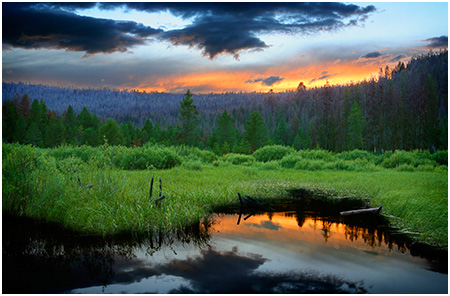
Sunset, Stanley Lake
Sunset, Stanley Lake is one of the first really colorful images that I have had success with. I grew up as a black and white photographer. I loved shooting large format black and white film. I developed my own film, printed my own images. The darkroom was my home. I studied Ansel Adams Zone System and felt like I had really mastered the art of black and white. The science behind it was a part of me. I no longer had to think about it, but could let the art in me come out because I knew exactly how to achieve the desired result.
Then came digital. I saw the advantages of digital first in my commercial work, so I jumped in, thinking all along that I would hang on to film for all of my personal work. It didn’t happen that way. I learned to control digital photography, not let it control me. I learned what it could and could not do. I began exploring color. That same love affair that I had initially with film was beginning to take shape with me and digital photography. In almost all of my early color work I used a very simple color palette, many times still monochromatic. That is the way I see. Then on one trip to Stanley Lake with my family, I found this image.
I had been out fishing and arrived back at camp just in time for sunset. I grabbed my camera and tripod and started walking. No more than thirty yards from our campsite I found this marshy area near the outlet. The sun had set just 10 minutes earlier and there was a haze in the sky that I later learned was caused by a wildfire that had started earlier in the day. I quickly set up and carefully composed and metered the scene. The light beautifully illuminated the haze and reflected in the water in the foreground, creating very strong color contrast in the image. The green grasses and bushes were illuminate by a wide open sky and seemed to glow. I was captivated not so much by the composition, but by the color. This was very different for me. It was an incredible feeling. I saw and felt something that I had rarely seen or felt before, and I was hooked.
I still do quite a bit of black and white work, but have now added color to my working palette. Photography for me is a journey, one that I very much enjoy. I will continue to evolve, change and grow, and as I do I will continue to share what I learn with any who wish to ride along with me!
by tmoffett | May 5, 2010 | Color, Critique, Landscape, Photo tips, Photographic Philosophy
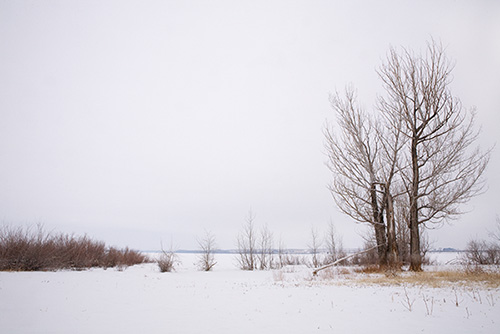
First Snow, Lake Lowell
I love photographing in the winter. My students all think I am crazy, but I love the quiet peacefulness that exists outdoors when it is cold, especially right after the snow falls. I usually photograph solo when it is cold, as I cannot convince anyone else to brave the elements with me. Many of my winter images convey a feeling of quiet loneliness, probably due to the fact that I am out in the elements, alone. I have time to think, meditate and relax. I am not rushed by anyone or anything. For all of these reasons I am drawn to scenes that peaceful and quiet. This image is no different.
The leafless trees, the fresh-fallen snow and overcast sky work together to create a feeling of restfulness. The small cluster of trees clinging together for strength amid the open, cold world remind me of my need to build strong relationships with those I love. This bonding helps me to not only survive the winters of life but to grow through them and become stronger.
I discussed with my students yesterday how a photograph can be much more than a picture. If the image maker truly puts him/herself into their work, then their images become stronger. They begin to tell stories and create feelings and emotions. That is when we start to become artists. We are no longer documenting a scene in front of us, but we are interpreting what life throws our way in a visual way. We are opening the doors of our souls to the world and letting everyone who may to feel what we feel and see what we see. It has become my method of expressionism.

Recent Comments