by tmoffett | Jul 29, 2010 | Color, Composition, Landscape
Reflections
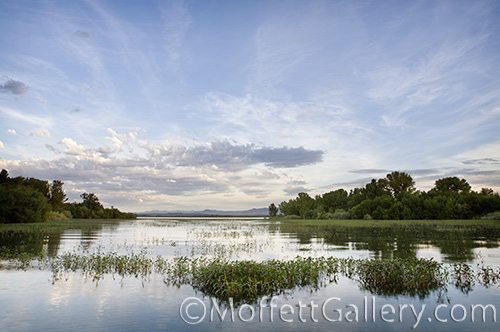
The illusion of three dimensionality in a photograph can be powerful. It pulls the viewer into the image and lets him/her roam around. You feel as though you are there, the scene unfolding right before your eyes. Lack of the illusion of depth and all you have is a piece of paper. Not too exciting to look at.
One effective method of creating depth in a landscape photograph is by using the concept of perspective, making sure that there are foreground, mid-ground and background elements in the image. These elements, when working together will capture your attention and then draw you in, allowing you to explore the scene as if you were really there. When I see an image with good use of perspective, creating depth, I often find myself wanting to examine every square millimeter of the photograph. It makes me feel as though I were there, and creating feeling is what photography is all about, at least for me.
by tmoffett | Jul 27, 2010 | Color, Composition, Landscape, Photographic Philosophy
Silence
A photograph that has no emotional impact is just a pretty picture. I have made a lot of pretty pictures in my life, but I hope that I have also created my share of meaningful images. I love photography. I love nature. Photographing is what I have always done and I will continue to do throughout my life. I got my first camera when I was about 8 years old and the journey began. At that time I made a lot of snapshots. I was documenting my life. My vision has changed and now I shoot to create images of what I feel. I search for meaning in my images. I often find myself in my photographs. Not physically, but emotionally.
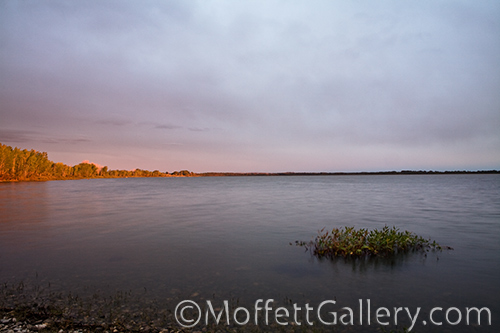
This particular image makes me feel something. It has a darker tonal range, yet the sky maintains some bright tones and has a sense of mystic about it. The dominance of cool colors and a few warm reflections from the setting sun scattered throughout. A world turned upside down with a few feelings of hope scattered about. It is about searching, reaching for something better, improving oneself, progressing. The composition supports this train of thought as you move from the rocks on the shore to the plants in the water to the trees reflecting the light from the setting sun and then progressing into the eeriness of the stormy sky.
I don’t often talk about what my images say or mean to me, as I like to let the viewer decide for themselves what the meaning is. Know this, though, that I am always photographing from the heart. I am passionate about what I do. I lose myself while photographing and often do not see the meaning right away. It is after the image is completed and I look into it and find myself, my thoughts and feelings, speaking quietly to my heart. This is how I work. This is me.
by tmoffett | Jul 24, 2010 | Color, Composition, Landscape, Photo tips
Just a Weed
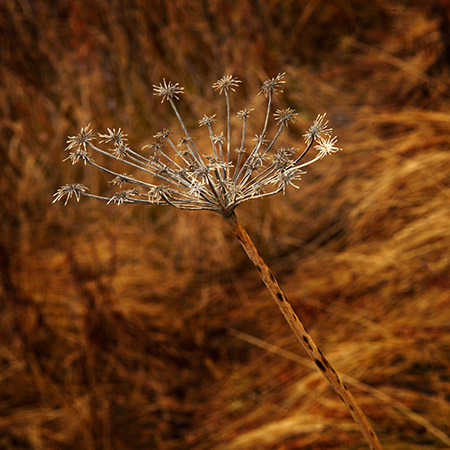
I know, it’s just the dried up remnants of a weed. I wish I knew the name of the plant so I could at least title it correctly, but I guess I didn’t study enough botany in school. Even though it is just a weed, look at the visual qualities of the image. The line and texture make it interesting to look at. The top of the plant is bursting out from the stem, almost like fireworks exploding from a mortar. By keeping the one plant sharp and blurring the background, even though both are the same color, the plant stands out, it separates from the background.
Controlling depth of field, so vital in creating photographs. I know, it is the technical stuff that many of us don’t want to get in to, but it is necessary if we are going to be in control of our art. With this image, I used a 70mm lens and moved in as close as it would focus. Due to being so close to the subject, my depth of field was very narrow, so much so that the near and far parts of the weed were out of focus, even at a moderately wide aperture. I actually needed to stop down to f16 to maintain crisp focus on the weed, but due to how close I was to it, the background fell off to a nice blur.
There are three things that factor in to effective depth of field. 1. Aperture 2. Focal length of the lens 3. Lens to subject distance. All three of these play a part in determining what will be in focus and what will not. We, as photographers must know our equipment and how to use it. In the example above, had I just thought that due to needing shallow depth of field I should set the aperture to f2.8, I would have been terribly disappointed. I am glad that I have learned the technical aspects of photography to the point of really not having to think about it so that I can focus on composing and creating art!
by tmoffett | Jul 23, 2010 | Black and White, Composition, Ramblings
Iced Over
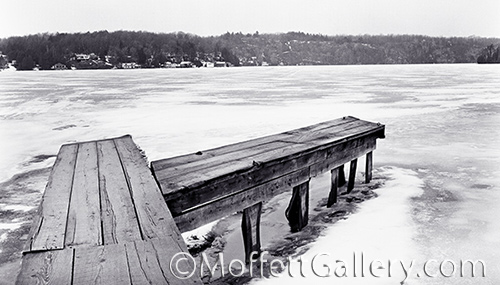
In an effort to wish cooler temperatures here, I am going to the archives and posing a winter picture today. This comes from a long time back when I was in Watertown, New York. One winter day I was out driving and came upon this old pier at a lake that I am not even sure what its name is. Anyway, it was cold. The pier was icy. I remember slipping and nearly falling on its icy surface while setting up this image. I love the angle on the pier as well as the texture, contrasting nicely with the icy snow covered lake.
This brings back memories of the days of film. I shot this with my Pentax 6×7 on Kodak TMAX 100 film. Occasionally I long for those days. The smell of fixer in the darkroom. Watching the image appear in the tray. Those little things that really hooked me on photography. Everything is so different now, yet in some ways it is the same. The tools have changed, but the concepts remain. The computer has become my darkroom. Many of my students today have never shot with film. They only know digital. I sometimes think that they are missing so much by not having played in the darkroom. The darkroom teaches a person to slow down and think about what they are doing. Nothing was instantaneous like it is now. So different.
by tmoffett | Jul 22, 2010 | Color, Composition, Landscape, Photographic Philosophy
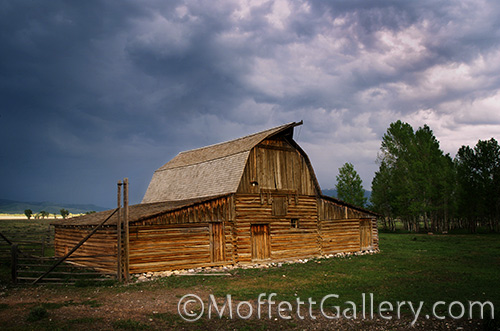
Old Barn near Jackson Hole, WY
Why is it that landscape photographers are drawn to old barns? I normally like my landscapes clean, but when there is an old barn in the scene, I will photograph it. All other man made objects or structures I want removed, but an old barn can stay.
I happened upon this barn just as the rain passed and I was able to watch the sun set while I photographed. The nice, soft, warm light of the setting sun with the storm clouds overhead made for a very nice composition. That is one thing that I try always to be aware of when shooting. What is the sky doing? If the sky does not enhance the image, then how can I minimize it? In this case, I love the sky, so I made sure to include it in the image. Remember, the background, in this photo, the sky, can make or break the photograph.
by tmoffett | Jul 20, 2010 | Color, Composition, Landscape
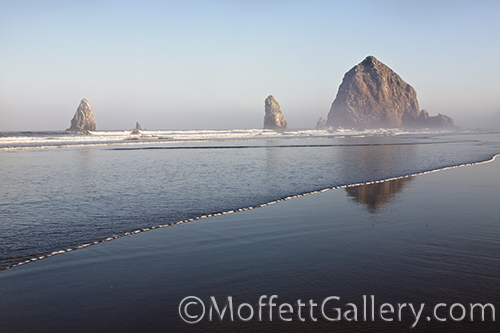
Haystack Rock
I have many images of Haystack Rock and all of them are different. The light is different each time I go to Cannon Beach. Other differences that influence the final images are the tides and weather. I never know exactly what I am going to get, but I am never disappointed. I love the surprise factor. It makes me work a little harder at times, but that can be a good thing.
The morning that I made this image of Haystack Rock, a marine layer began forming and thickened throughout the day. You can see the haze forming just above the ocean and creating an interesting band that breaks up the blue of the sky and the blue of the ocean. As I set up for this shot, I watched the waves coming in and placed myself where I could catch the edge of the incoming water to create a line leading from the edge of the frame to sea stack, then I waited. The Needles, just to the left of Haystack Rock help to visually balance the composition.

Recent Comments