by tmoffett | Feb 17, 2011 | Color, Photographic Philosophy
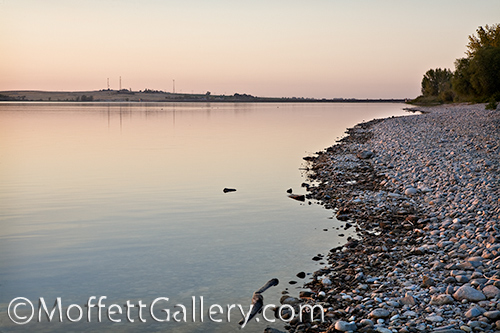
Evening at the Lake
It is amazing to me how the same place can look so different nearly every day. I have photographed from Gotts Point on Lake Lowell numerous times, yet different result every time. Sometimes it is the light and atmosphere, other times it is me and my attitude. How we think affects our vision, and when shooting from our hearts, that will affect the images we make. Finding my vision has been a lifelong quest for me, and I find that even though I may have developed a consistent style, my vision changes daily. What I am feeling is what my photographs become.
by tmoffett | Feb 3, 2011 | Color, Landscape, Ramblings
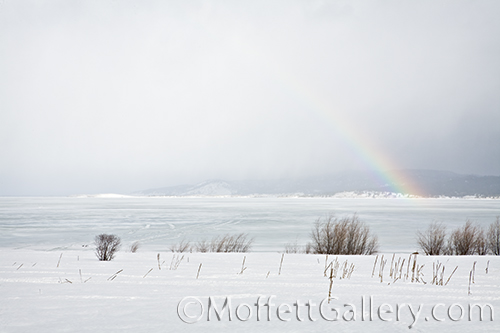
Rainbow in the snow
A week and a half ago, Christeena and I spent the weekend in Cascade and McCall just relaxing and enjoying life. No pressing plans, just regrouping and getting ready for the next wave of action at the Moffett house. It proved to be a much needed break. While in Cascade, we drove, or should I say skated around the lake. The roads were iced over and even with my new studded snow tires we did more sliding than driving! I enjoyed the drive while Christeena became a nervous wreck, as she thought that every time we slid a little we were going to end up stuck in a snowbank or in the lake. I probably would have been the same had I been in the passenger seat. I’m sure it didn’t help matters when I was paying attention to the scenery, looking for photo opportunities more than watching the road!
As we rounded a bend and had a great view of the frozen lake, the snow was blowing and then the sun attempted to peak through the clouds, and as it did this rainbow appeared. I don’t ever recall seeing a rainbow in the middle of a snowstorm before. It was quite the sight. I got out in the storm to photograph this interesting phenomenon. The above image is the result.
by tmoffett | Feb 1, 2011 | Color, Landscape, Photographic Philosophy
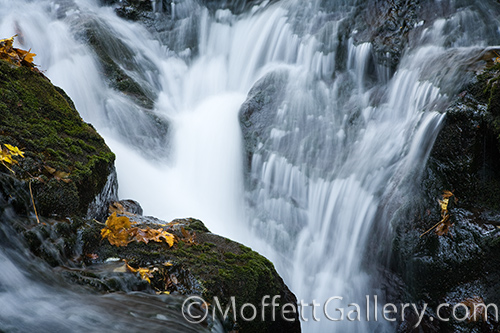
Fall on Sweet Creek
A short hike up Sweet Creek in the Fall is a wonderful sight. Even with the lower water levels, the water cascading down the mountain is incredible. I walked about a one mile stretch and lost count of how many little waterfalls I found. If you ever get the chance, this is definitely one hike you must take. I have made this same trek in the late Spring, and oh, how different it is. Water levels high and running so fast that it is nearly impossible to photograph well. It is just a mass of whitewater from top to bottom. In the Fall I was able to get right down to the waters edge and really explore. I like to photograph from within the image, using wide angle lenses instead of from a distance. When I can really feel the image I am better able to photograph it with emotion. It is not just about framing up a pretty picture, for me it is about experiencing the scene and then reproducing what I feel. Sometimes it is a small detail, others the grand vista. But always it includes my feelings.
by tmoffett | Jan 26, 2011 | Color, Landscape, Photographic Philosophy
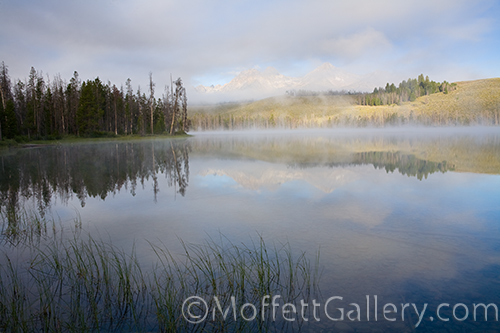
Reflections, Little Redfish Lake
What is style in photography? Is it important to have a style? How do you develop a style?
These are questions that I am frequently asked when teaching and mentoring, so I thought it would be a good topic to discuss here. Style is the unique characteristics of an artists work that differentiates them from other artists. It is very important to have your own style in order to succeed as an artist. Style is what makes you identifiable. Without it, why would anyone want to own one of your photographs? That identifiable style is what will make your images valuable.
I have found that consciously developing a style is difficult. A style will develop on its own as you learn to shoot from the heart. You can practice technique, and, as you do you will begin to find your own style. You will be drawn to certain subject mater or certain lighting conditions. The more you photograph the more defined a style will become. While studying other photographers images and identifying with others work that you enjoy will assist you in identifying your own style, I don’t believe that style development can be pushed. It will just happen as you study and practice. The more you photograph the faster it will develop.
I remember the first time I realized that I had a recognizable style. I had been working tirelessly on a set of images to be displayed in a gallery early on in my career. After delivering the images to the gallery and getting them hung I stepped back to look at the work as a whole. I was taken aback as I could see similarities that tied the individual images together into one work. I could see myself in the photographs in a way I never before had. It was inspiring to see. I had seen it in other artists work, but never before in my own. Since that day years ago, I have noticed my style evolve and become more refined. It continues to change in a way that defines who I am as an artist. My life, my thoughts, by beliefs. My style is who I am.
by tmoffett | Jan 24, 2011 | Color, Composition, Landscape, Photo tips
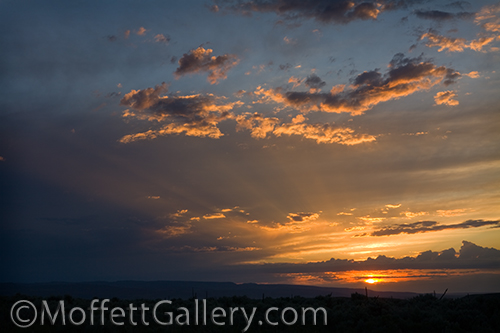
Sunset, Cassia County, Idaho
Sunsets are wonderful. Never the same, they provide so much opportunity to explore color and light. Some are subtle, filling the sky with pastels while others vibrant and deep. Nearly always, though, you will find at least some patches of blue that complement the reds and oranges that fill the sky, adding depth to an already beautiful scene.
While it seems that such incredible scenes are hard to go wrong with in photography, taking some time to carefully compose and think about the scene will greatly enhance your ability to capture it most impressively. Here are a few tips to photographing the sunset.
1. Use a tripod! This is a must for nearly any landscape photography. I use small apertures and low ISO settings to maximize depth of field and color saturation, and the result means a slow shutter speed. Hand-holding will ensure motion blur which is normally completely unacceptable.
2. Compose carefully. Using a tripod helps me to slow down and make sure that everything is near perfect. Level the horizon. Can you use the rule of thirds or is a symmetrical composition better? Check and recheck and then shoot.
3. Shoot a series of images as the sun sets. You might think you have the best image, break down and and move on only to realize that the color gets even better later. I love photographing after sunset. Often my best image is 10-20 minutes after the sun has completely disappeared over the horizon.
4. Bracket the exposure. Exposure is critical with sunsets. Over-expose and you lose saturation, under-expose and you get noise. You really need a perfect exposure in order to get a high quality print.
by tmoffett | Jan 10, 2011 | Color, Landscape
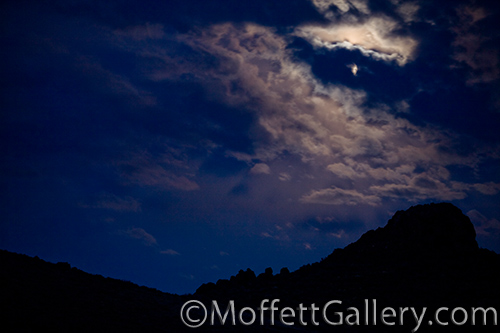
Owyhees with a Full Moon
I love being in the outdoors. A fall night found me out with one of my boys on a scouting trip in the Owyhees when the clouds rolled in and the light from the full moon illuminated them in a mysterious way. I was in awe as I watched the constant change as the clouds moved and covered the moon, then later the sky would open back up and be full of light. I took several exposures of the night sky, some with a silhouetted foreground and others without. This image, to me really shows the feeling of the night. The deep blues and partial cloud cover exudes a feeling of wonder, quite moody. It is what I look for, images that evoke feeling. The subject matter really doesn’t matter if the light is right.

Recent Comments