by tmoffett | May 10, 2010 | Color, Composition, Critique, Photo tips, Photographic Philosophy

Rusted Hinges
I asked a class of beginning photography students today if they had done any shooting over the weekend, and I had a student reply with, “No, I don’t drive so I couldn’t go anywhere to photograph.” It brought back the memory of when I was in school and having Ruth Bernhard visit and do critiques for several of us students. She questioned, “How far did you travel to make this image.” Her point being that you don’t have to go any farther than your own backyard to find images to photograph. Be observant. Learn to really see the world.
Rusted Hinges is an image that I created without traveling. In fact, I had seen this hundreds of times before really seeing it. This scene is just outside the back door of my former studio space. I saw it every morning and evening as I came and went for nearly 10 years. One evening as I was leaving, the light just happen to be falling on the side of the building in such a way as to capture my attention. I returned to the studio to get a camera and this is what I came up with.
Look at the door. The texture of the peeling paint on the wall. The way the brick and the weeds frame the wall and door is interesting to me. But through everything that is going on in this image, the hinges, the rusty hinges of the door are what really interest me. I see decay, urban decay. This images speaks of the issues facing historic downtown areas that used to be thriving with the bustle of business, but now sit vacant and in disrepair.
The elements of this image all came together in a successful manner not because of my great photographic skills and talents, but more so because I have trained my eye to see and recognize when the elements are there. Acting upon that instinct I was able to create an image that still remains one of my favorites.
by tmoffett | May 6, 2010 | Color, Composition, Critique, Landscape, Photographic Philosophy
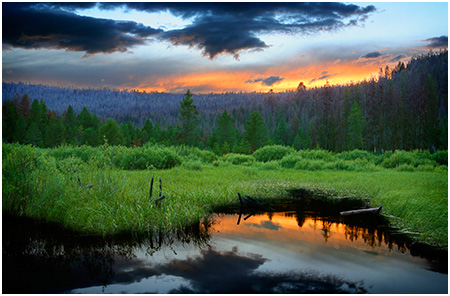
Sunset, Stanley Lake
Sunset, Stanley Lake is one of the first really colorful images that I have had success with. I grew up as a black and white photographer. I loved shooting large format black and white film. I developed my own film, printed my own images. The darkroom was my home. I studied Ansel Adams Zone System and felt like I had really mastered the art of black and white. The science behind it was a part of me. I no longer had to think about it, but could let the art in me come out because I knew exactly how to achieve the desired result.
Then came digital. I saw the advantages of digital first in my commercial work, so I jumped in, thinking all along that I would hang on to film for all of my personal work. It didn’t happen that way. I learned to control digital photography, not let it control me. I learned what it could and could not do. I began exploring color. That same love affair that I had initially with film was beginning to take shape with me and digital photography. In almost all of my early color work I used a very simple color palette, many times still monochromatic. That is the way I see. Then on one trip to Stanley Lake with my family, I found this image.
I had been out fishing and arrived back at camp just in time for sunset. I grabbed my camera and tripod and started walking. No more than thirty yards from our campsite I found this marshy area near the outlet. The sun had set just 10 minutes earlier and there was a haze in the sky that I later learned was caused by a wildfire that had started earlier in the day. I quickly set up and carefully composed and metered the scene. The light beautifully illuminated the haze and reflected in the water in the foreground, creating very strong color contrast in the image. The green grasses and bushes were illuminate by a wide open sky and seemed to glow. I was captivated not so much by the composition, but by the color. This was very different for me. It was an incredible feeling. I saw and felt something that I had rarely seen or felt before, and I was hooked.
I still do quite a bit of black and white work, but have now added color to my working palette. Photography for me is a journey, one that I very much enjoy. I will continue to evolve, change and grow, and as I do I will continue to share what I learn with any who wish to ride along with me!
by tmoffett | May 5, 2010 | Color, Critique, Landscape, Photo tips, Photographic Philosophy
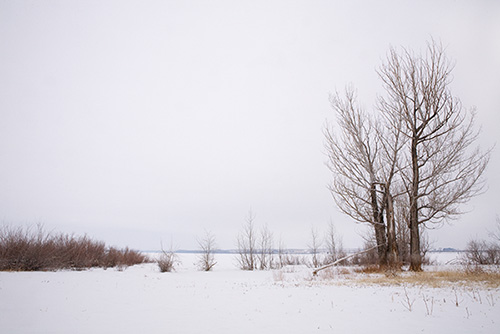
First Snow, Lake Lowell
I love photographing in the winter. My students all think I am crazy, but I love the quiet peacefulness that exists outdoors when it is cold, especially right after the snow falls. I usually photograph solo when it is cold, as I cannot convince anyone else to brave the elements with me. Many of my winter images convey a feeling of quiet loneliness, probably due to the fact that I am out in the elements, alone. I have time to think, meditate and relax. I am not rushed by anyone or anything. For all of these reasons I am drawn to scenes that peaceful and quiet. This image is no different.
The leafless trees, the fresh-fallen snow and overcast sky work together to create a feeling of restfulness. The small cluster of trees clinging together for strength amid the open, cold world remind me of my need to build strong relationships with those I love. This bonding helps me to not only survive the winters of life but to grow through them and become stronger.
I discussed with my students yesterday how a photograph can be much more than a picture. If the image maker truly puts him/herself into their work, then their images become stronger. They begin to tell stories and create feelings and emotions. That is when we start to become artists. We are no longer documenting a scene in front of us, but we are interpreting what life throws our way in a visual way. We are opening the doors of our souls to the world and letting everyone who may to feel what we feel and see what we see. It has become my method of expressionism.
by tmoffett | May 1, 2010 | Color, Composition, Critique, Landscape, Photo tips
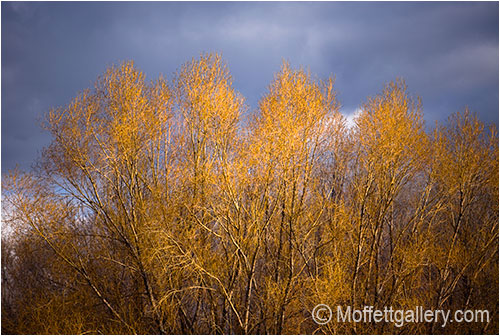
Evening Light, Downey, Idaho
The May Print of the Month has just been posted at MoffettGallery.com. Each month I offer a new print in an edition of only 50 prints at a 30% discount for one month only. It has proven to be a great way for many to start collecting our artwork. All images come matted and ready to frame.
This months image, Evening Light, Downey, Idaho, is another image that was created on an excursion with my wonderful wife, Christeena. Some friends invited us to meet up with them for a weekend getaway at Downata Hot Springs, and we had a great time. As we traveled to Downey, about a 6 hour drive, we found some interesting places, however the light was just not right. Shortly after arriving at the hot springs, though, the sun dropped to the horizon left us engulfed in this warm, wonderful light. Down near a pasture, just a short walk from the yurt we were staying in, I found this small grove of trees almost glowing in the light. The dark, cloudy sky made a perfect background. When looking at this image I am filled with warmth like that that radiates from the sun on a cool summer evening. With this image, I am also captivated by the lines created by the light reflecting off of the branches in the bottom third of the photograph.
The visual effectiveness of this image comes from not only the great light found that evening, but from proper selection of camera settings as well. A shallow depth of field was rendered by selecting an aperture of f2.8 and using a high shutter speed. The shallow depth of field and focus point on the near tree branches, the ones catching the light, causes them to stand out and create dimension in the image. I shoot the majority of my landscape images with a very long depth of field (f22 or more), but in this case, just the opposite was needed to make it work.
by tmoffett | Apr 20, 2010 | Color, Composition, Critique, Family, Landscape
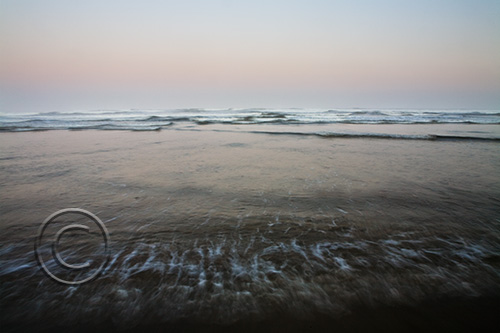
Pastel Sunrise, Cannon Beach, Oregon
This was my first morning ever on the Oregon Coast. We arose early to be on the beach at sunrise, and we were not disappointed! As the sun began rising in the east, the light haze over the ocean to the west created a soft pastel sky. It was beautiful. Christeena and I spent the morning walking the beach, photographing the ocean, watching the light change as it gradually fell on Haystack Rock, listening to the sounds of nature, talking, soaking it all in. After the sun rose and the quality of light diminished, we headed to Pig’N Pancake for some fresh blueberry pancakes. We spent the rest of the day hiking, exploring tidepools and relaxing. Great company, good food and a wonderful atmosphere. I couldn’t have asked for anything more.
This image is quite unique for me. It has a very soft, almost painterly feel to it. It is very simple yet quite complex at the same time. There is just enough motion in the water to give it a soft feeling, yet still sharp enough to keep the shape of the waves intact. The closer you look, the more you see. The vertical motion of the foam in the foreground counters with the horizontal lines created by the waves in the midground to inject a bit of tension and excitement, yet the overall feel is still very calm. The image is almost monochromatic, yet there is just a hint of pastel color in the sky, created by the early morning light as it interacted with the haze hanging low over the ocean. The .6 second shutter speed was just slow enough to capture a sense of movement, yet just fast enough to maintain some detail. Any faster or slower and the image would not be nearly as effective at creating feeling and emotion.
by tmoffett | Apr 19, 2010 | Color, Composition, Landscape, Photo tips
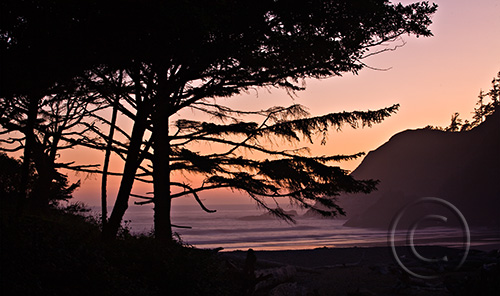
Sunset, Ecola State Park
This is another image from my Oregon Coast series. This was our second night on the coast, and that day the marine layer moved in and left it hazy for us all week. At first I was disappointed, but realizing that it wasn’t going away I tried to find images that worked with it. One good thing that it did do was create great color as the sun lowered in the evening sky. I am a black and white shooter, but when you get color like this… well, what else can I say. It did set the stage for some wonderful, romantic evenings.
I love the strong horizontal composition in this image paired with the wonderful warm tones of the sunset suggesting peace and tranquility, warmth and comfort. Capturing a silhouette like this is not to difficult a technique to master. Using a spot meter, meter the sky and increase the exposure about 1 stop. In this case, my meter read f/16 at .6 seconds, so I shot at 1.3 seconds, obviously with the camera on a tripod. To avoid camera shake I always lock the mirror up on my Canon 5D and use a cable release.

Recent Comments