by tmoffett | Jul 25, 2010 | Color, Landscape, Ramblings
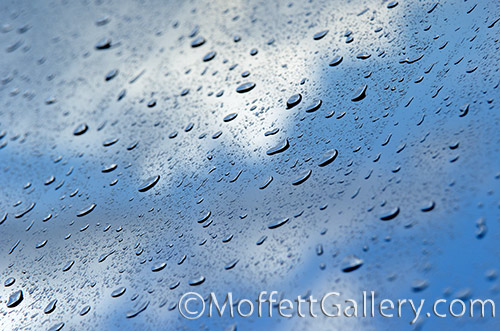
Blue Sky and Raindrops
Weather. It is so unpredictable. I was out photographing one late afternoon with the most perfect weather, then almost out of nowhere came the rain. I retreated to the car as the rain was really coming down. Just a few minutes later, it cleared off again and I was able to resume shooting. That is the kind of weather we have in Idayo. If you don’t like it, wait 10 minutes.
While I was sitting in the car, I watched as the rain came down on the windshield. Each drop would hit and then bead up on the glass. It was quite interesting to watch. Just as it stopped, the sky began to clear and this scene opened up to view. I grabbed my camera and made a couple of exposures before resuming to shoot outdoors. As I focused on the drops from inside the car, I could see the sky, soft on blurry, in the background.
I guess my point today is to always be on the lookout for images. Be observant. Learn to see. There are opportunities wherever we are to be creative. It really isn’t about where you are, but how and what you see.
by tmoffett | Jul 24, 2010 | Color, Composition, Landscape, Photo tips
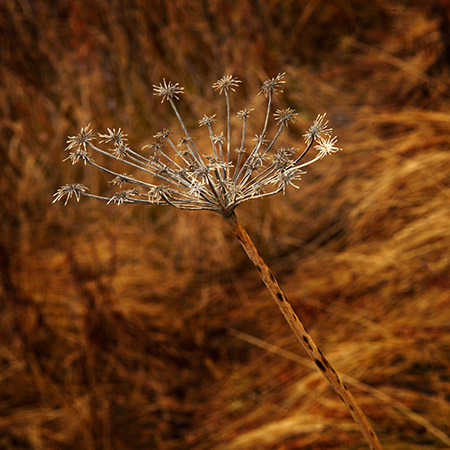
Just a Weed
I know, it’s just the dried up remnants of a weed. I wish I knew the name of the plant so I could at least title it correctly, but I guess I didn’t study enough botany in school. Even though it is just a weed, look at the visual qualities of the image. The line and texture make it interesting to look at. The top of the plant is bursting out from the stem, almost like fireworks exploding from a mortar. By keeping the one plant sharp and blurring the background, even though both are the same color, the plant stands out, it separates from the background.
Controlling depth of field, so vital in creating photographs. I know, it is the technical stuff that many of us don’t want to get in to, but it is necessary if we are going to be in control of our art. With this image, I used a 70mm lens and moved in as close as it would focus. Due to being so close to the subject, my depth of field was very narrow, so much so that the near and far parts of the weed were out of focus, even at a moderately wide aperture. I actually needed to stop down to f16 to maintain crisp focus on the weed, but due to how close I was to it, the background fell off to a nice blur.
There are three things that factor in to effective depth of field. 1. Aperture 2. Focal length of the lens 3. Lens to subject distance. All three of these play a part in determining what will be in focus and what will not. We, as photographers must know our equipment and how to use it. In the example above, had I just thought that due to needing shallow depth of field I should set the aperture to f2.8, I would have been terribly disappointed. I am glad that I have learned the technical aspects of photography to the point of really not having to think about it so that I can focus on composing and creating art!
by tmoffett | Jul 22, 2010 | Color, Composition, Landscape, Photographic Philosophy
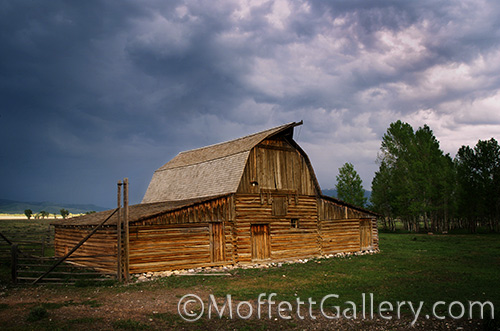
Old Barn near Jackson Hole, WY
Why is it that landscape photographers are drawn to old barns? I normally like my landscapes clean, but when there is an old barn in the scene, I will photograph it. All other man made objects or structures I want removed, but an old barn can stay.
I happened upon this barn just as the rain passed and I was able to watch the sun set while I photographed. The nice, soft, warm light of the setting sun with the storm clouds overhead made for a very nice composition. That is one thing that I try always to be aware of when shooting. What is the sky doing? If the sky does not enhance the image, then how can I minimize it? In this case, I love the sky, so I made sure to include it in the image. Remember, the background, in this photo, the sky, can make or break the photograph.
by tmoffett | Jul 21, 2010 | Color, Photo tips
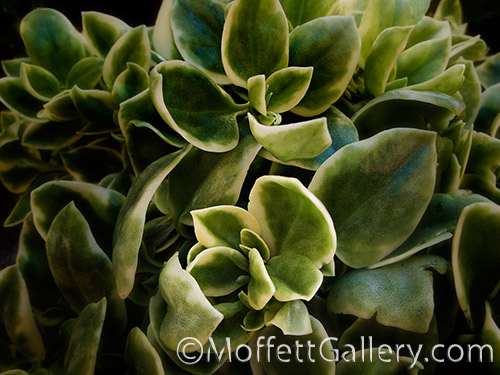
Untitled
I very rarely photograph in the middle of the day. The light is harsh and direct. I have to work too hard to control the midday light, so I just don’t do it. However, I took some students on a field trip one day, and it just happened to be during the midday sun. What do you do? I look for smaller subjects, the landscape within the landscape, or as I like to call them, intimate landscapes.
This small plant I found just outside one of the buildings on the Boise State University campus. It was in total shade, but had a little bit of light being reflected on it from a pillar at the entry to the building. This soft, directional light is just what was needed to highlight the tips of the leaves and maintain good detail in both highlights and shadows, something that is near impossible to do in the direct sunlight at noon.
With smaller subjects, it is quite easy to block the direct light and create a soft directional reflected light. Some things that I have done in the past is to block the light with my own body, and often times if I am wearing a light shirt, that will reflect just enough light to do the job. Other times I will use a piece of mat board to provide the shade. Black foam core is a great tool to keep on hand for these situations. By blocking the light with black and bouncing in some light with white foam board you can gain total control over the light.
Remember, photography is all about the light. Learning to control and manipulate the light will give you a creative edge over those who can’t. It will most certainly open doors for creativity that would otherwise remain closed. It is one way to take your work to the next level and separate you from the amateurs.
by tmoffett | Jul 20, 2010 | Color, Composition, Landscape
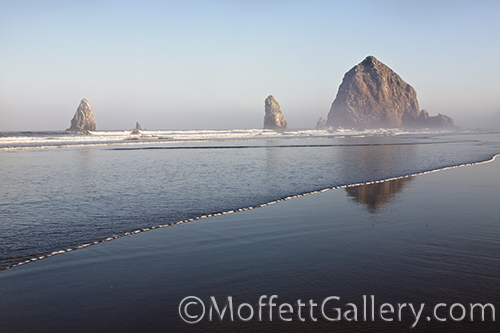
Haystack Rock
I have many images of Haystack Rock and all of them are different. The light is different each time I go to Cannon Beach. Other differences that influence the final images are the tides and weather. I never know exactly what I am going to get, but I am never disappointed. I love the surprise factor. It makes me work a little harder at times, but that can be a good thing.
The morning that I made this image of Haystack Rock, a marine layer began forming and thickened throughout the day. You can see the haze forming just above the ocean and creating an interesting band that breaks up the blue of the sky and the blue of the ocean. As I set up for this shot, I watched the waves coming in and placed myself where I could catch the edge of the incoming water to create a line leading from the edge of the frame to sea stack, then I waited. The Needles, just to the left of Haystack Rock help to visually balance the composition.
by tmoffett | Jul 18, 2010 | Color, Family, Photographic Philosophy
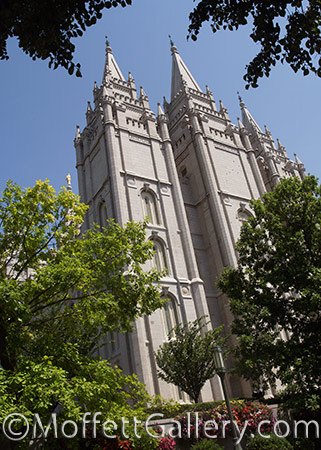
Salt Lake LDS Temple
I love the song Photographs and Memories by Jim Croce. This photograph is one that brings back great memories for me. It is where Christeena and I were married over 20 years ago. We have had a great life together and I look forward to an eternity of happiness with her!
Making photographs is one way that we keep memories alive. Not every photo is a masterpiece or a work of art, nor need it be. Often, as a photographer I have a hard time taking “snapshots” because I have it in my head to make every shot count. I slow down and think too much when I should be shooting away, and before I know it the moment is gone. For this reason, Christeena takes most of our snapshots. I need to change. There is a time and a place for the artwork, and a time and a place for snapshots, and I need to learn the difference.
Sometimes a photograph can create great memories and be a piece of art at the same time. This image was created years after our marriage while on a family trip back to the Salt Lake area. While helping the younger kids at a drinking fountain I looked up and saw this image. I had wanted to make a photo of the temple that was different than all of the others I had seen, and this just happen to be the one. Fortunately I had my serious camera with me and I quickly set up and made the image. A 20×30 print hangs in my house as a reminder of that wonderful day more than 20 years ago.

Recent Comments