by tmoffett | Aug 18, 2010 | Color, Photo tips, Random images
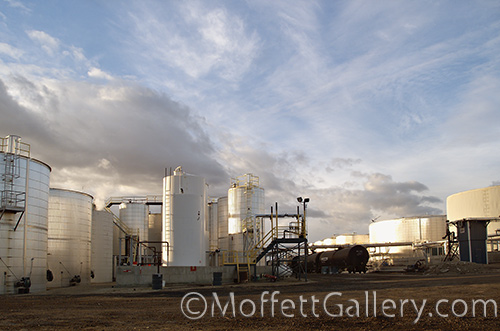
Tanks And Trains
On occasion I get the chance to shoot commercial photographs for some medium to large businesses based here in Idaho. On this occasion I was photographing a large asphalt plant. How do you make a big industrial area with large storage tanks and rail cars look inviting and interesting? It is all about light.
Originally this company wanted me to shoot earlier in the day, and I insisted that to get what they really wanted I needed to be there later. They agreed to my terms and afterward were very pleased with the images. I waited until just before sunset so that the light was softer and at a lower angle, thus having the ability to create shape and form from the tanks. With the softer light, the black rail car also held detail while the lowering sun struck the sides of the white tanks creating three dimensional depth. As a bonus, we had a few light clouds in the sky to add some nice texture to an otherwise blue sky.
Remember, photography is all about the light!
by tmoffett | Aug 17, 2010 | Color, Composition, Landscape
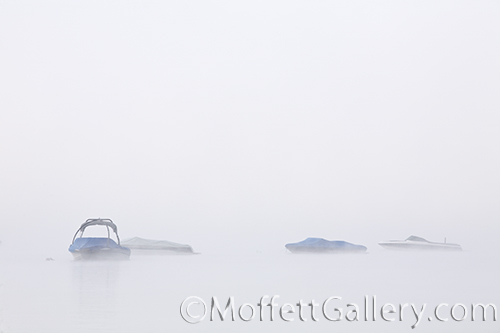
Summertime Fog, Redfish Lake
Had to post another image from last weeks trip to Stanley, Idaho. It was such an unusual look for this time of year. The simplicity of the scene created by the fog, as it minimizes the contrast and the background distractions was captivating. I am always looking for simplicity in my images as that is what I am. Just a simple photographer living a simple life. The concept of “less is more” really works here. It is a hard concept to teach, but when mastered is very effective.
by tmoffett | Aug 15, 2010 | Color, Landscape, Photographic Philosophy
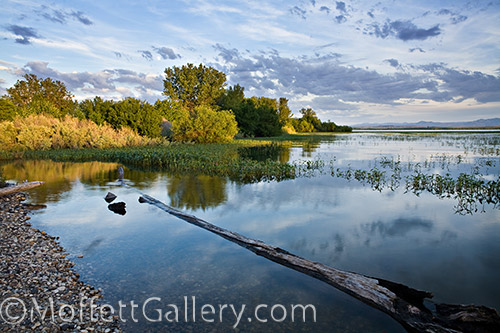
Summer Sky
Like it or not, we’re back! The fishing was good and the photography was great around Stanley, Idaho! We photographed around the Stanley Lake area, Little Redfish Lake and Alturas Lake. I have not had time yet to process out the images, but check back often, as they will be showing up in future entries. The morning fog in the valley was quite incredible. Very fun to photograph in. We had a great time, and it was much needed to get away from everything, including cell phones and the internet for a couple of days. It was very refreshing for the mind.
Due to not having finished any images yet from this trip, I have dug into the archives for today. This photograph is of a section of Lake Lowell that I pass frequently when riding my bike. The interesting thing about Lake Lowell, and just about any location, is the constant change. As the water level drops during the year due to irrigation, the shoreline changes. I think I could shoot along the banks every day and find something new. Sometimes it is the light that changes, sometimes the scene is changed and sometimes I see it differently because my attitude has changed. All of these things affect my photography, but of the three, I think attitude has the most effect. So if you find yourself in a rut and having a hard time finding an image, look inside yourself. I have found that if I have the right attitude and mindset, something will always present itself.
by tmoffett | Aug 12, 2010 | Color, Landscape, Photo tips
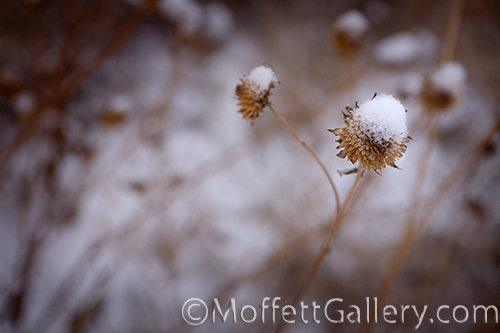
Early Winter
Do you ever need to de-emphasize a busy background? I know on occasion I do. In portraiture this is an everyday situation, but a technique that is not used as frequently in landscape photography. However, it is very valuable to understand at times.
This particular scene, if shot on auto or with a point and shoot camera would be so busy that we really would not be able to tell what the main subject is. By utilizing a wide aperture (f4 in this case) the background becomes very soft, just a nice texture that visually disappears. The main subject, remaining sharp, stands out. It creates three dimensional depth. To take control in these situations, you must understand the relationship between aperture (f-stops) and shutter speeds. As you open up the aperture, the shutter speed must decrease proportionally. By doing this, your exposure remains constant and the depth of field becomes shallow, thus creating the desired effect. Most of the time in landscape photography, we are wanting just the opposite effect, small aperture and long shutter speed, giving you a much greater depth of field.
by tmoffett | Aug 11, 2010 | Color, Photographic Philosophy, Ramblings
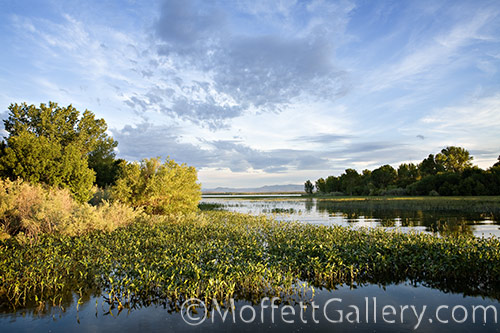
Lake Lowell
Why do I photograph? Because I need to! I got my first camera when I was about 8 or 9 years old, and have been documenting life and the world we live in since then. My reasons to shoot and my photographic philosophies have changed over the years, but I still have a need to create images. I must share my vision with the world.
I love photographing locations that I regularly visit. I love the ordinary. I like to show it in extraordinary ways. It is my vision. We walk past subject matter daily that could make great images if we only took the time and effort to recognize it. I think we tend to ignore more great photographs than we see. We must force ourselves to slow down and learn to see as though we were looking at things for the first time. We must look with new eyes. We must look with new light. When the light is right, everything looks good. Recognizing the light and seeing the composition is what really makes a great photographer. These skills must constantly be honed in order to create meaningful photographs. It is a challenge.
That is why I photograph.
by tmoffett | Aug 10, 2010 | Color, Landscape, Photo tips
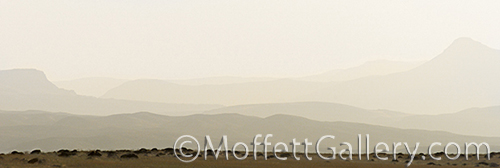
The Owyhees
I have had this image as the banner on the blog now for several months, but have never discussed it. It is one that I really enjoy, even though it is not perfect. I had just finished photographing a family at Celebration Park, which overlooks the Snake River just outside of Melba, Idaho. I was tired. It had been a long day and I just wanted to go home. However, as I drove out of the park, I saw this view of the Owyhee Mountains and had to stop. This is one of the few times that I didn’t use a tripod for a landscape image. I did, however, rest the lens against the open window frame of my car. I knew I needed a camera support, but was just too tired to get everything back out. The car did the trick. I have printed the image up to 44 inches and it is very sharp. I know that without some sort of support, though, it would have been soft and unprintable. This is one case where knowing how to get the support quickly and easily paid off.
Many of my students complain about needing to use tripods, so I try to show them different methods to accomplish the same thing. Even though there are other methods of supporting the camera, I find that most often a tripod is still the easiest method. I always carry a tripod. Even if I don’t have a camera, I have a tripod. It very rarely leaves my truck. I have just found that it is so important of a tool. When I don’t use it, I always find that I wished I had. I just cannot hold the camera as still as a tripod does.

Recent Comments