by tmoffett | May 26, 2010 | Black and White, Landscape, Photo tips, Photographic Philosophy
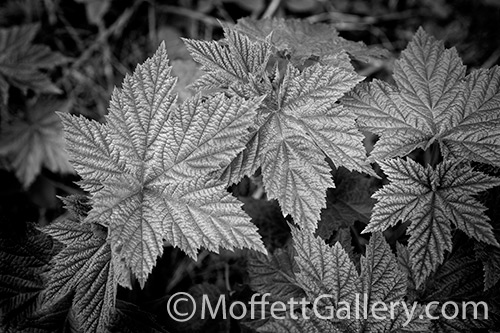
Silver Beauty
It amazes me how many times I hear students say, “I can’t find anything to shoot.” Developing a vision and then becoming aware and truly observant of our surroundings are skills that every successful photographer must have. It takes time and practice to develop these skills. Many mistakes will be made along the way, but from every mistake we can learn, and by learning we become better. The only way to develop your own vision is to get out and make photographs. Often. Daily, or at least weekly whenever possible.
Evaluating your images is the second step to developing vision. Self-evaluation is good, but critiques from mentors and peers is even more effective. We must learn to accept constructive criticism and grow from it in order to reach our potential. We become so involved in our own work that often we fail to see our shortcomings. Even to this day I seek out critiques from my associates. I want to know how my photographs make them feel. What would they do differently?
Silver Beauty is a result of all of the above. I was on a school outing with one of my boys, and I got up early, stepped outside the cabin and found this scene. Just a small leaf, but the light falling on it was wonderful. After making the original print, I asked several of my photographer friends what they thought. I considered their feedback, made a couple of changes and then watched the print go loan at Professional Photographers of America annual print competition.
by tmoffett | May 25, 2010 | Black and White, Landscape, Photo tips
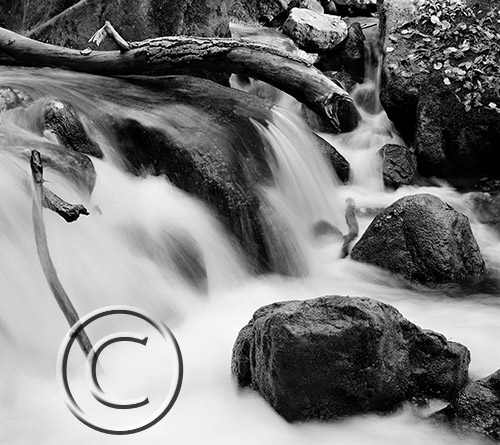
High Creek
Yesterday, as I was writing, I got to thinking about photographs I have made in the past with water. The image posted today, High Creek, is one of my earliest successful photographs of water motion. I guess I have been drawn to water for quite some time, but recently I have become more aware of how much it interests me. I have spent a lot of time on a personal project of documenting Lake Lowell, and I guess that that is one of the reasons I have become more aware and fascinated with the characteristics of water.
I don’t thinks I am alone in this fascination, either. It seems that many of my students love water as well. I am asked over and over how to capture the smooth, silky images of flowing water. The principle is very simple. Use a tripod and shoot with a slow shutter speed. This leads to a perfect assignment for a beginning class, as it forces the students to practice the principle of equivalent exposure. They can see immediately the difference between using a long shutter speed and small aperture and using a short shutter speed with a wide open aperture. Once equivalent exposure is mastered, it seems to open up a whole new world of creativity to beginning photographers.
by tmoffett | May 20, 2010 | Black and White, Landscape, Photo tips, Photographic Philosophy
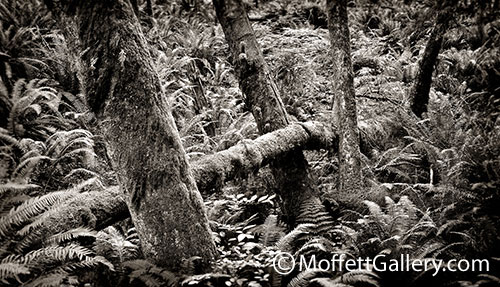
Fallen
I love black and white photographs. I grew up as a photographer shooting almost exclusively black and white film. I loved the darkroom. the smell of the developers and fixer. I think that developing and printing my own work for years has made me a better photographer. I learned to see how the camera sees. I learned to make correct exposures. If I did make a mistake my darkroom work was much more difficult. I also had to make decisions on paper types, warm or cold toned, contrasty or flat, and many others. Experimentation cost money. In a nutshell, I learned to pre-visualize the end result at the time of exposure. With the advent of digital photography, I find this is becoming a lost art. It is too easy to try everything before the final print is made.
Even though I am now shooting mostly digital, I still practice pre-visualization. At the time of exposure I already know what the finished image will look like. I can then make the correct exposure to maximize quality and minimize post-production work. This image, Fallen, is an example of this process. Color was never an option. The warm toned image also portrays the feeling of life better here than a cool toned image would. This is what I saw when I shot. A warm, inviting image with good tonal separation between the moss covered trees and the heavy undergrowth. A calming feeling of peace. When looking at this image I can almost smell the fresh, moist air. It’s almost as if I were there.
by tmoffett | May 19, 2010 | Black and White, Landscape, Photo tips
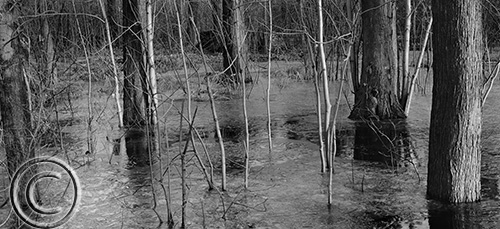
Evening Light
Photography is all about the light. In this image, the low, evening light skims across the surface of the ice, showing every bump and ripple. Instead of blasting into the tree as the early afternoon sun would do, the softer light from the sun on the horizon gently brings out the texture in the bark. Every square inch of the image is packed with detail, helping to create an inviting feeling rather than just being a pretty picture. It is the quality of light that transforms an otherwise ordinary scene into an extraordinary photograph.
by tmoffett | May 18, 2010 | Black and White, Landscape, Photographic Philosophy
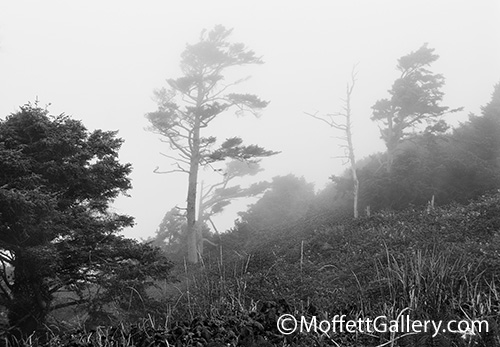
Coastal Fog
I mentioned in an earlier post about my visit to the Oregon Coast, and that we were socked in all week with the marine layer. At first I was disappointed, but realizing that it wasn’t going away, I began photographing it. This is an image that would not have existed without the fog. I love the depth, softness and mystery created by the mist. As I tell my students, there is always something to photograph. We just need to open our eyes and be observant. Having a positive attitude always helps as well. As was the case here, until I decided that even though it was not what I had originally expected, there was beauty here to be captured, I didn’t find it. Attitude, vision and mastery of equipment and technique make all the difference.
by tmoffett | May 17, 2010 | Black and White, Composition, Landscape, Photo tips
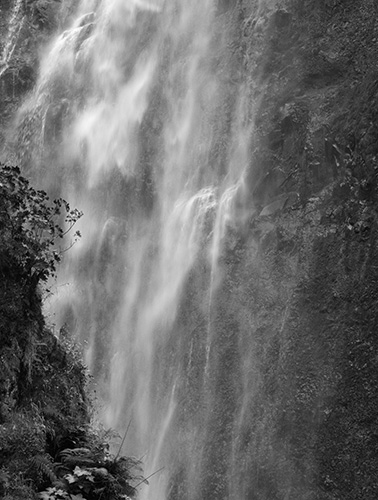
Multnomah Falls
The other day I was showing my students a Dewitt Jones video on creativity. He talked about shooting Yosemite Falls, and it brought back memories of when I was at Multnomah Falls in Oregon. I started by shooting the entire falls, very postcardish. Interesting, but not very creative. I felt like it was nothing special. Anybody could do that. So I started looking for what was really interesting, as Dewitt Jones would say, “another right answer.” I found just a small section of the whole image that to me made a much bigger statement. The sharp, crisp foreground placed against the flowing water of the upper falls was wonderful! It had depth. It had mood. It had feeling. It was different.

Recent Comments