by tmoffett | Mar 23, 2012 | Color, Composition, Landscape, Photographic Philosophy
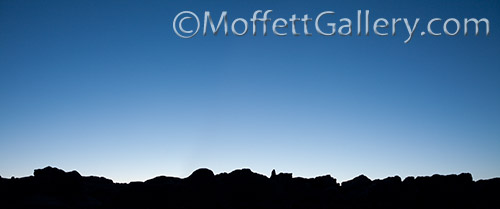
Clear Night, Arches National Park
It’s Spring Break here in Idaho, and time for another photography field trip! I’ll be photographing near Moab, Utah for the next few days and I am really looking forward to it. These kind of trips are very refreshing and help keep me fresh. It seems like a while since I have been out of my “Home Territory,” and will be a much needed break. I am a real advocate of photographing where you live, however an occasional road trip with the camera will do wonders for the revitalization of the soul.
In anticipation of this trip, I was reviewing some images made from a trip to Moab last summer. I came across this panorama that I shot at the end of the day when it was just about too dark to even focus the camera. That is one of my favorite times to shoot. It was a cloud free night and I found this horizon line to be quite interesting. It looked kind of like my lifeline, some ups and downs, maybe some bumps and bruises, yet constantly moving forward. I usually like a few good clouds, but this image, with its clean and simple design works just fine. God is the ultimate designer, and if we are observant enough, can find the beauty in whatever He places in front of us. That is the challenge. Find the beauty in the chaotic world in which we live. It is there. We must just simplify our vision in order to find it.
by tmoffett | Mar 21, 2012 | Color, Landscape, Photographic Philosophy, Photographic Technique
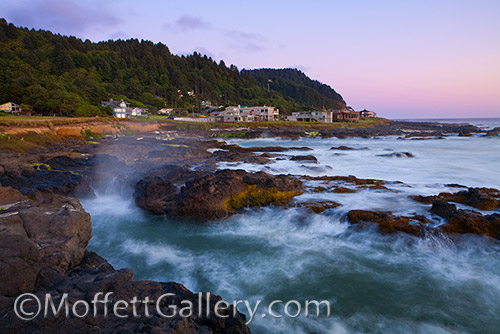
View From Ocean Drive, Yachats, OR
Photography means writing or drawing with light. Knowing this, it would then make sense that the better the light, the better the photograph. As simple as this concept may seem, it is sometimes hard to get students to understand it. So often I hear students in the process of researching other photographers work question why their own images don’t look more like the professionals. More often than not it comes down to light. You may be in a great location and have a great composition, but without great light you’ll end up with a mediocre photograph.
As the sun moves across the sky the color and quality of light that reaches the surface of the earth changes. The warm, soft light at sunrise turns to a cool and harsh light with deep shadows by mid-morning on a cloud-free summer day. By late evening the warm, soft light with rich, open shadows returns and slowly change to a soft cooler light after the sun sets. Coming to know these changes and learning to recognize what light quality will produce the mood and feeling that you want to elicit in your finished photograph are key to creating powerful images. For landscape photography, more often than not the early morning or late evening will produce the most desirable result.
There is one time of day that is often forgotten when it comes to making photographs; after the sun has set. I will often arrive at a location and watch as others are packing up and leaving and I am just getting started. A tripod is a must for making photos after sunset, but the mood and feeling rendered can be quite unlike anything that can be captured during the day. I will work many times until it is too dark to focus the camera.
The image above was taken just after sunset. You can see the warm pastel colors on the horizon, shifting to cooler tones in the upper sky. The warm light still on the horizon skims across the surface and illuminates the west face of the rocks and the buildings, while the cooler light from above illuminates the shadows and reflect off of the water. These subtle shifts in hue are what create some of the drama and interest in this image. Being patient and waiting for the right moment to press the shutter is much of what photography is about. Ansel Adams said, “Sometimes I do get to places just when God’s ready to have somebody click the shutter.” I believe that Ansel Adams had a very good understanding of light and placed himself at the right places and at the right times to take advantage of the beauty that God put in front of his lens.
by tmoffett | Mar 19, 2012 | Black and White, Landscape, Photographic Philosophy, Photographic Technique
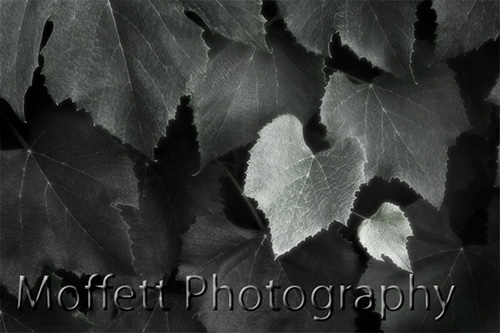
Grape Leaves
One of the most frequently asked questions by students in my classroom while working on photographs in Photoshop is, “What should I do to this image?” Nearly always my reply is the same. “What did you see and feel when you photographed it?” This concept of visualizing the end result before pressing the shutter button on the camera is becoming a lost art, yet is so important to achieving consistent, meaningful and powerful results.
I began to understand the idea of previsualization while studying Ansel Adams zone system under the tutelage of Craig Law at Utah State University. When making exposures using the zone system, a photographer must first know what he/she wants because the exposure settings (aperture and shutter speed) and film development process is determined by what the finished print is to look like. The whole process is very calculated. One must slow down and think about the image that is about to be created. Some may claim that this attention paid to the technical details takes away from the spontaneous art of photography. I differ with this way of thinking. Slowing down, really looking and taking in a scene allows me the opportunity to feel my surroundings. I am able to focus on my emotions. What is it that caught my attention in the first place? Why do I feel I need to make a photograph? What do I really see? What emotion do I want to elicit in the viewer of the image I am about to make? These are just some of the questions that I ask myself while setting up to photograph a particular scene. Only after I have taken the time to experience the scene that I am about to photograph am I able to determine how best to replicate those emotions in a photograph. Once those decisions are made, there is no question as to how to process the image upon returning home. I have already experienced it!
Even though I now use advanced digital equipment instead of film for my photography, the principle of previsualization learned years ago is still prevalent in my methods of working. When out photographing, I first pay close attention to my emotional response to the scene in front of me. If I have no emotional response, the photograph will have no power. This determines whether or not I even take the camera out of the bag. After deciding that a scene is indeed worth photographing and what emotional response I want to evoke, I can then successfully determine the correct exposure settings, lens selection, white balance, ISO, etc. are necessary to convey my message. At the same time, processing and editing methods are determined as well.
All of this takes time and effort. By slowing down and thinking, even meditating while photographing, you too can learn to create more powerful images while actually making fewer exposures.
by tmoffett | Mar 14, 2012 | Color, Landscape, Photographic Philosophy
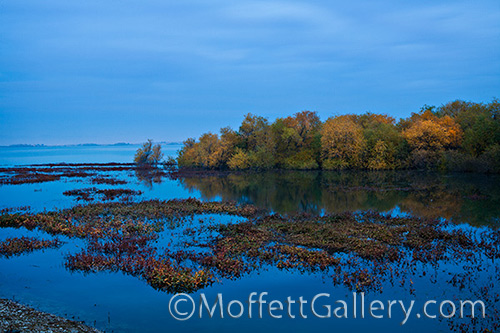
Midnight Blues, an image from Silent Solitude
My silence has been long enough. I have decided to return to the world of blogging after a longer than expected absence. It seemed as though my life was beginning to revolve around my daily blogging. I was losing touch with the things of most importance. My family was suffering. My photography was suffering. Most importantly, I was suffering. Trying to keep up with a daily blog entry that had content that would benefit my followers was too much, so I am returning with a different format. I will be writing content on a regular, but less frequent basis. Two to three times a week new content will be added in a way that, hopefully, you will find beneficial, interesting and fun to read. I will continue to add new photographs with each post as well.
During my absence I have been busy. I just finished my first book, Silent Solitude. I have been photographing at our local lake, Lake Lowell, over the past several years, and have compiled my favorite images as well some of my ramblings about my photographic and artistic philosophies into a coffee table book. The book contains more than 60 images made during all seasons of the year and shows the quiet side of the lake. Even though there is much recreational activity at the lake, a quiet, serene setting can be found. I work in the very early and late hours of the day, many times after everyone else, including other photographers have packed up and gone home. I find inspiration while working on a moonlit summer evening or in the early hours before the sun rises. The colors are rich and the water is calm. While walking the shoreline I can meditate, uninterupted by the chaotic sounds that fill the daytime hours. It is my way of maintaining sanity in an insanely busy world.
The photographs in this volume are an extension of my innermost feelings. They are more than just pictures, they are me. They are what and how I see, how I visualize the environment in which I live and work and play. By channeling my feelings and my emotions into my photographs, I attempt to allow the viewer to experience a bit of what I feel when I am making the image. When successful, the images become more than photographs, they become art.
To purchase Silent Solitude, click on the button in the sidebar. A full preview of the book can be found at blurb.com.
by tmoffett | Feb 17, 2011 | Color, Photographic Philosophy
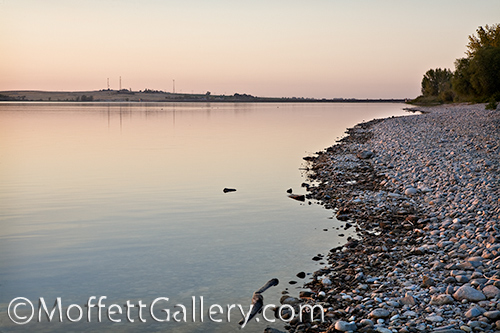
Evening at the Lake
It is amazing to me how the same place can look so different nearly every day. I have photographed from Gotts Point on Lake Lowell numerous times, yet different result every time. Sometimes it is the light and atmosphere, other times it is me and my attitude. How we think affects our vision, and when shooting from our hearts, that will affect the images we make. Finding my vision has been a lifelong quest for me, and I find that even though I may have developed a consistent style, my vision changes daily. What I am feeling is what my photographs become.

Recent Comments